

A Different Look At Social Media and Important Changes Coming
Labels: Connecting, Convergence, innovation, Jobs, Marketing, New Media, noise, ReadWriteWeb, social media, social networking, trends ReadWriteWeb is a fantastic blogsite...informative and broad-reaching in its coverage of new media. Great resource worth a bookmark. Yesterday, they posted an article with a bit of a contrarian point of view on social media.
"Making Money" is perhaps the biggest challenge social media must face.
Here were some of their posted thoughts:"Social media" was the term du jour in 2008. Consumers, companies, and marketers were all talking about it. We have social media gurus, social media startups, social media books, and social media firms. It is now common practice among corporations to hire social media strategists, assign community managers, and launch social media campaigns, all designed to tap into the power of social media.
With all the great excitement of social media lately, yes, they are right. It is noisy and messy, filled with an endless array of tools and gadgets.
But social media today is a pure mess: it has become a collection of countless features, tools, and applications fighting for a piece of the pie.
Facebook, a once groundbreaking online community, has become the ant colony of third-party applications. Twitter users now have a dozen or so additional applications they can use to overcome Twitter's ever-present shortcomings. People spread themselves across a number of tools and maintain different networks on each (large portions of which they don't even know), making it nearly impossible to decide what to share and with whom.
Users, marketers, and companies face an incredible amount of noise, too. For every new application that relies on a network, another crops up that helps users manage it. While "eyeballs" used to be the coveted metric, both ad publishers and investors now realize that having smaller well-targeted niches can lead to much better returns than marketing to one large undifferentiated mass of users.
Meaning and connection -- two key anchors of all things social media -- are corroding by the day as people's ability to organize their experiences and find the relevance of their networks declines. Social media, in essence, is bumping up against its own ceiling, no longer able to serve the needs of those living within its walls; and for these reasons, social media as we know it is changing course.
So what needs to change? Again, some of ReadWrite Web's top thoughts as social media continues to evolve:1) It's About People. We're moving away from "users," "customers," and "shoppers": social media is bringing back the human element to all digital interaction.
While this year be the year social media and "making money" converge successfully? Or is that still years away?
2) Creating Meaning and Value. Social media will no longer be about features and applications. These have become a dime a dozen. People will be looking to get tangible and relevant value out of their social experience; they'll be looking for meaning and for order.
3) Enabling Convergence. People are at a loss when it comes to pulling their conversations together from various sources and assigning meaning to them.
4) Building a Truly Cross-Platform Experience. In the new landscape of social media, people are seeking solutions that seamlessly cut across mobile, web, and live interaction.
5) Creating Relevant Social Networks. People will create, join, and seek social networks that enable them to have meaningful and relevant experiences with each other. They will measure their return on investment (time spent, level of disclosure, etc.) in replies, comments, their ability to influence, and the value of their learning.
6) Innovating in the Advertising Space. Ad publishers and the attached ecosystem will continue to lose revenue until they realign their understanding of what appeals to people who are conversing, connecting, and expressing. The next phase of social media is a gold mine of targeted niche demographics.
7) Helping People Organize Their "Old" Social Media Ecosystem. As aggregating platforms enter the field, people will seek to bring order to the endless bits of information available to them. Video tagging, conversation archiving, taking cloud computing to the next stage, and making search more relevant are some of the new baseline requirements. These represent a significant opportunity for companies willing to undertake this massive endeavor.
8) Connecting with the Rest of the US and the World. With some exceptions, today's active social media users are early adopters. In the next one to two years, the benefits of social media will cross the chasm and reach the mainstream.
9) Preparing for New Social Media Jobs. Social media's new job descriptions will call on subject-matter experts who can plan for relevant interaction within networks and aggregating platforms and bring together products, services, and people.
10) Making Money. The next phase of social media will bring plenty of lucrative opportunities. With the rise of aggregating platforms, social networks, and new mobile and location-based features, we're bound to see an increase in targeted and personalized ads, "freemium" packaging, revenue sharing between strategic partners, and a flow from the offline world to online social engagement (such as when real goods complement virtual ones).
posted by Unknown @ Wednesday, January 28, 2009,
,


Social Media Tips: A Quick List of Helpful Links
Labels: Facebook, New Media, social media, social networking, tips, Twitter, Web 3.0 2008 was the year social media networking sites and micro-blogging tools exploded to near-mainstream usage. This year promises only more growth for social media.
In Canada, there are 8 million Facebook members...for a country with 24 million on the Internet. That's one-third of Canada found on just one site!
Just this month, Facebook became twice as large in usage than MySpace...with a total of 150 million active users.
Twitter was no longer just a tool to track celebrities on their rhinestone-encrusted smartphones; it became THE way to pre-promote for any savvy marketer.
Whether you are just now getting into social media or you are already in the know, these current articles should be great idea generator and navigators for you:
>> 50 Ideas on Using Twitter for Business
>> ...And here's a list of 42 quick and cool social media tips...
>> Understanding and Aligning the Value of Social media
>> Why You Should Be Looking at Twitter
>> How To Sell Social Media to Cynics, Skeptics and Luddites
>> Social Media Rule #1: Always Give 'Em Something To Talk About
>> A Guide to Media Tweeter Lists
>> Web 2.0 is So Over, Welcome to Web 3.0
>> Want to See Where The Media Is Going? Follow the Money
>> FlowingData -- one of the better tweeting social media leaders. FlowingData.com is the website...
>> ...Oh, and this guy is pretty good, too.
>> Track the top twitter elite users, get twitsnips, badges, button makers and search by region, topic and more at TwitterGrader
>> Create free customizable Twitter backgrounds
But...is Twitter killing blogs and blogging?
posted by Unknown @ Tuesday, January 27, 2009,
,
Social Media and Traditional Media: Seize the Opportunity
Labels: New Media, social media, social networking, Twitter, Web Trends
Social media is all the rage online.
But do you know what it means or how it works? How much time have you spent "digging" in and learning from the latest tools? Webinars are available almost daily from hundreds of online businesses exploring the infant power of micro-blogging and interlacing all of a company's online and traditional media platforms.
And how exactly do you "sell" it...to your CFO or other financial decision makers, let alone to the marketplace for revenue?
Traditional media -- radio, TV and newspapers -- are far behind the curve here. And sadly, the good people still slugging it out in traditional media hardly have the time to learn on their own as they've been saddled with staff cuts and more than one-job-to-many to cover for the people let go.
For the past few weeks, I've been re-immersing myself in social media. Had to...I was a staff cut. It's fascinating and exciting. You can literally "see" the growth right there in front of you. Online. But what about with radio...any growth happening there?
Sure, in places, but it's not so easy to see it. While radio groups generally continue to record strong quarterly cash-flow/EBITA profits and are maintaining healthy revenues, all the weak economic forecasts for the entire advertising industry eclipse (at least for now) any good news stories about radio. While initiatives like Virgin Radio in Canada could bear positive fruit, it was immediately followed up with 23 job cuts for Astral. On the same day it was announced Clear Channel in the U.S. cut 1,850 jobs. After a year where CBS Radio has cut 750 cuts from their 140 station group.
The public knows -- and the market knows -- growth industries don't cut jobs. When industries are hiring -- when companies have a hard time filling their open slots for talent -- the public and the market gives that industry their confidence and can see the growth. They want to invest because they see the companies investing in themselves. Cutbacks only mean one thing -- growth is somewhere else.
You want to see growth? Just look at these stats.
So where can radio get growth again? Where can it invest?
Social media.
Right now.
Oh, and it might want to consider a few more things. Here's some suggestions:
• Treat your station like a social media website...a place that consistently refreshes and surprises with new content, supplied by the talent, programming and, most importantly, by the listeners (through twitter, IM, email comments, etc. and recorded and live messages). Let THEM contribute; tear down the wall between the station and the listener. Make sure your website includes all the tools for your talent AND your listeners to participate and contribute new ideas and general commentary on whatever THEY choose (of course, staying within community standards).
• Make sure your website is the center of multiple destinations all related and pointed to each other on the web, through fans and group profiles on Facebook and MySpace, etc, Twitter, blogs, and more.
• Be the most local media for your community and, specifically, your target audience.
• Pay attention to what your listeners need and make sure you remain flexible as an organization to give listeners what they need...not maybe sometime in the near future.
• Avoid template formatting. Keep every station locally-distinctive to that market, even if it voice-tracks or uses syndicated programming. Your sound and your unique content (even it is re-packaged) is your unique selling proposition.
• Stop sounding exactly the same every day with your announcers using nearly the same 180 words during their show as they used the day before, only in a slightly different order. Your listeners want to know "what's new", not "what's the same".
• Get away from auto pilot programming. Yes, it is cheaper to run in auto pilot and it does create short-term operating gains...but radio is reaching (or already has reached) the tipping point of being forever branded as stale -- to the public, to advertisers, and to investors -- as new media (and the universal praise for new media) constantly remains new -- and even more new tomorrow. Build more custom programming (even when pre-produced) and adapt operational structures to manage it.
• Encourage talent to do new things, to explore...even within mostly music/tight formats. Encourage them to try and to seek out...and allow them the room to apply that on-air. Nurture them more to grow, learn and apply in fresh ways.
• While we need brand consistency, that doesn't mean what we program on Tuesday should sound exactly like it did on Monday. Around the set playlist, the local, live and fresh content matters! The question talent needs to ask itself before every show is "What does my listener need to know about today?"
• If you choose to promote something, never do it halfway (or less). Promote it with all your muscle and creativity, with no excuses. And never water it down by trying to promote more than one major thing at a time. If it's important, it should become what all of your audience is talking about.
Radio is a healthier media platform than it realizes. It is still a heavyweight of the media class. But it needs a new training program that can help it keep up with the times. It needs the leadership and the courage to invest in the right areas for present and future growth. Where do you want to go today?
Here's some more suggestions...and a great primer to catch you up on the reasons why.
Hold on a second, I just got tweeted...
Chris Kennedy is a media trend watcher, radio program director, market researcher, change agent and strategist serving media companies throughout the U.S., Canada, Europe and South America. Look for him his at twitter.com/kennedycs, facebook.com, the Jointblog for media trend watching, email him at kennedycs@yahoo.com or call 514-826-9250.
posted by Unknown @ Friday, January 23, 2009,
,
Radiohead To Give Away New Album; Major Labels Freak Out
Labels: Being digital, Connection, Content, Control, Convenience, Corporate, Digital media, downloads, mainstream media, New Media, New music, Radiohead The digital age causes headaches for all traditional media companies trying to hold onto their business models. They like the control of their content which they distribute through their owned connections to their consumers at the prices they decide, all at the media company's convenience.
Control, Content, Connection, Convenience -- the consumer battle over the four C's which the Jointblog and Joint Communications has referred to for years.
The digital age reverses these rules.
In the digital age, it is the consumer making the decisions.
The consumer decides the content they want -- how, when, were and even if it is consumed.
The consumer decides the price they want -- if they don't like the price, they find it for less (or for free) somewhere online.
The consumer decides -- at their own convenience -- what matters and what doesn't.
It is the consumer that is in control.
Now, there's news a major recording act -- considered by many fans and music critics to be among the best bands in the world over the last decade -- is offering their brand new album for free download. And the consumer can choose how much they want to pay for it, if they want to even pay anything at all.
The band: Radiohead.
It's an unusual -- but brilliant -- step to tell fans that they can pay as much or as little as they like for the band's new album "In Rainbows". In essence, they are telling their fans "it's up to you" what they pay to digitally download the album.
And they make it easy, without ripping anyone off or wasting anyone's time forcing them to watch an embedded commercial the consumer doesn't want to see.
As The Telegraph reports:Radiohead is free to sell its album directly from its official website because it is no longer tied to a record label. So far the album is only available to pre-order from the website, where it can be downloaded on release on October 10.
What exactly does this get Radiohead, since it doesn't guarantee revenue or profits?
While loyal fans are likely to want to pay the band something, customers could opt to pay as little (as) the credit card handling fee.
Credibility.
And it strikes a blow against corporate dominance.
It makes Radiohead fans love the band more.
And, my bet is plenty of fans will pay comparable fair value for a new CD anyway...because they know what is fair and what isn't.
Mainstream Media, are you listening?
Do you hear the rules changing?
posted by Unknown @ Monday, October 01, 2007,
,
Media Trend Watching: Annoying Banner Ads
Labels: 2006, Ad dollars, Advertising, Annoying, banner ads, IAB, Internet, Media Trend Watching, New Media, PwC, Revenue, Snark More ad dollars keep going to the Internet.
Last month, the Interactive Advertising Bureau (IAB) and PricewaterhouseCoopers (PwC) announced that Internet advertising revenues for 2006 were estimated to be $16.8 billion, a 34% increase over the previous revenue record of $12.5 billion in 2005.
Globally, 2006's Q4 totaled just under $4.8 billion -- the highest quarter ever reported.
Nine short years ago, total spent Internet advertising in the 4th quarter (1997) was just $424 million...more than an eleven-fold increase.
These ad dollars are being spent on search marketing, paid search links, streaming video ads, contextual GoogleAds, email campaigns and many other forms. Among all choices, the most popular -- and often most annoying -- are banner ads. Sure, they deliver "eyeballs"...but many of them are just plain bad. That can't be great for ROI and certainly not for brand building strategies.
American may love streaming video...but the only people who like the banners ads next to the video probably are advertisers.
I found an article for "The Top 5 Most Annoying Banner Ads on the Internet". No doubt you've seen these banner ads while visiting your favorite sites. They're everywhere. While it may be difficult to ever narrow it down to only a Top 5 Most Annoying (given there are so many available), the logic is sound (although there's no scientific basis for their list).
Here's the selections from Cracked.com (thanks, Cracked!):
The Jointblog avoids banner ads (except to get snarky with them). Which banner ads annoy you? And which ones do you think work?
5) TBS Very Funny Ads. This is everything that's wrong with the modern media in one convenient image, for the busy modern person who needs to lose faith in humanity 'on the go'. A website dedicated to the commercials which prevent you from watching the programs on television....Worse, they're targeting the most annoying demographic on the planet: the "I only watch it for the ads" vacuum-headed smirkers.
4) Win a Free Thing. Banner ads used to promise instant free prizes, but even the dumbest internet surfer eventually realized that just maybe there weren't magical love-powered companies dedicated to giving free electronics to everyone on the planet...One thing all these ads have in common is legalese fine print which, like mobile-phone cancer and minesweepers wrist, is a disease of modern society.
3) Surveys. It's looking for people to complete marketing surveys, but only gets the kind who click on banner ads. The sort who can be distracted from what they're doing by the chance to fill out a form! People who need time and a roughwork sheet to answer the question "Is this object shiny?"
2) Emoticons. In the beginning, there were text smileys. And it was good. People who could spell transmitted thoughts around the globe, finding uses for neglected keys to generally acting like smart people. But with the advance of technology the ability to "use a computer" or "think with mouth closed" are no longer required to get online and banner ads are ever ready to harvest the new subliterate hordes. And topping the list (drum roll, please...)
1) Juggling Animation (scaled down in size to minimize the annoyance). The makers of these eye-wrenching monstrosities have fixated on "Get their attention," forgetting that it's part of the larger sentence, "Get their attention so they want to buy our product/service, and ideally aren't motivated to track us down, cement our legs into the pavement, and slowly tear our heads off with a length of chain and a monster truck."
Update at 6pm: The Fark forum board is posting many comments about more bad banner ads, such as this comment:There are worse banner adds (sic) than those. The mortgage dancing people, animals, anything with that freaking mortgage company. Anything that flashes so that I have a seizure while I am trying to do something. Then there is this annoying windows one I ran into yesterday. I thought it was because of windows but it only happened on this one website..and it was about weight loss...IT DROVE ME NUTS. So yeah anything that resembles any kind of error window.
Tell us more...what other bad banners do you despise?
posted by Unknown @ Friday, April 06, 2007,
,
Content Matters...But Distribution Rules In Media
Labels: Big Media, Content, Distribution, Google, Jointblog, Media Trend Watching, New Media, Time, Traditional Media, Viacom, What's Next, YouTube Distributors are the ultimate media gatekeeper.
When Time magazine named "You" as its 2006 Person of the Year, it attracted mixed critical response. Some thought it was brilliant, others thought it was a cop out. Whatever. That editorial decision did announce something fresh: one of traditional media's pillars of print media acknowledged the cultural significance of today's digital new media reality.
2007 has delivered major changes within Time, including mass job cuts, retirements and restructuring as well as a new delivery date (Fridays instead of Mondays). It's also brought about many design updates and content adjustments, intended to tighten up the partnership between the weekly magazine and the daily updates of Time.com.
Among the subjects Time features more is a regular look at "what's next" in consumer tech and media, which grabs this media trend watcher's attention. This week's "Curious Capitalist" writes that "Google Gooses Big Media" (wha?...what exactly does that mean?...has Big Media's butt been pinched?). For a traditional (mainstream, or MSM) print media publication to say "The search giant rewrote the rules of distribution and selling ads...The big movie, TV and print outfits may never catch up" is startling.
Why?
Well, first of all, they're admitting Google is now the leader steering media's growth -- not the TV, Print or Movie industries (and, by its absence, certainly not radio).
Secondly, while it's good news one of the biggest mainstream media publications in the world acknowledges new media's (and specifically Google's) importance in the total media mix...this "news" arrives several years late.
Lastly, Time Inc's viewpoint seems completely opposite of Viacom's effort to turn YouTube into SueTube.
The article does drive home excellent points, especially how it puncture's the tired adage that "content is king"."Content is king." It's a phrase uttered repeatedly by media executives making the case that the movies, music, TV shows, books and journalism their companies produce are the core of their business.
Yes, content matters...but that's a bit of a smoke screen. Distribution of content is what's always mattered. The owners of printing presses since the 17th century. The owners of radio towers and transmitters throughout the 20th century. The same has been true for the record/music industry, the TV industry, the cable industry...and now the top domains online.
It happens to be a dubious claim. Sure, movies, music and TV shows have value...But they alone have never generated the huge, reliable profits that keep investors happy and pay for midtown-Manhattan skyscrapers. No, the big money in media has always been in distribution.
Sometimes the media companies do this distributing themselves -- big media have long been defined by their ability to make sure their products are displayed prominently there. "The historical media play," says consultant John Hagel, "is having privileged access to limited shelf space." Extending content value through syndication rights and efficient distribution "pipelines" (or "networks" or high-speed wireless linkages, etc.) is really where it's at. Always has been...and it continues to be that way.
The trend: Mainstream media is still slowly figuring out new, better ways to marry its traditional media distribution system with its online distribution opportunities. As archaic copyright rules over content control evolve (such as DRM), will regulations tighten or relax? The battle over the next 5 years will be fierce and worth watching.
What do you think?
posted by Unknown @ Sunday, March 18, 2007,
,
Copy That! Viacom Sues Google for $1 Billion
Labels: Copyright Infringement, Google, Lawsuit, Media Trend Watching, New Media, Traditonal Media, Viacom, YouTube After years of watching Google's market cap soar and the Internet organize itself around Google's search engine findability, Viacom stepped in today and launched a billion dollar lawsuit, citing Google's unauthorized use of Viacom's content.
Blockbuster news...and not surprising, is it? The book publishing industry went nuts 4 years ago when Google's Book Search Project began (where Google digitally scanned and made available for search the complete text of books). Last month, additional royalties were approved to benefit audio creators, piling on more (prohibitive) costs for any radio stations streaming music online.
It was inevitible one of the major media video content creators would step up and say "enough...now pay up". And Viacom (with all its subsidiaries) is the world's biggest.
Good thing Google set aside about $400 million of its $1.65 billion YouTube purchase price to settle these claims (yes, they they were anticipated) but if the Viacom lawsuit it any indication it may get more expensive than that. What is Google? Ultimately, it's a web navigating tool (or an agent) capitalizing on other people's content. Or, more specifically, other company's content. The public quickly discovered Google serves a valuable function in society.
However, corporate content owners have never happy with it; not only did Google take away some of their own brand buzz, they were also "stealing" content/$$$ (and profiting from that "stealing").
Nevermind that Google's service happened to build a brand new way to connect and interact directly with your customer, including selling, advertising, branding, promoting and sharing.
Last month, after months of negotiation attempts, Viacom decided to partner with upstart Joost instead of approving content-usage on YouTube because no usage/revenue deal could be worked out with Google. So Viacom demanded YouTube pull all Viacom content off the site.
However, Viacom might have a valid point (will the courts agree?). Prior to Google, if you wanted to know what was "happening", Viacom's MTV Network was the place to find out. Once Google became dominant on the web, MTV Networks's lost their grip among younger consumers. It was faster and better just to "Google" it.
Update @ 12noon: So how did Viacom/MTV Networks break the news to its people? Click here.
Google has been the epicenter of new media expansion since the dot com bust of 2000. Traditional media grudgingly accepted the benefit of piggybacking Google to get content found (expanding content to a wider online audience), even if it meant a loss of control over their owned content.
Google's success is simple too big for traditional media's comfort.
According to Reuters:Media conglomerate Viacom Inc. said on Tuesday that it was suing Google Inc. and its Internet video-sharing site YouTube for more than $1 billion over unauthorized use of its programming online.
C|net also has a report on this story here.
The lawsuit, the biggest challenge to date to Google's ambitions to make YouTube into a major vehicle for advertising and entertainment, accuses the Web search leader and its unit of "massive intentional copyright infringement."
Viacom filed the suit with the U.S. District Court for the Southern District of New York, seeking more than $1 billion in damages and an injunction against further violations.
Viacom contends that almost 160,000 unauthorized clips of its programming have been uploaded onto YouTube's site and viewed more than 1.5 billion times.
"YouTube's strategy has been to avoid taking proactive steps to curtail the infringement on its site," Viacom said in a statement. "Their business model, which is based on building traffic and selling advertising off of unlicensed content, is clearly illegal and is in obvious conflict with copyright laws."
Viacom said its decision to sue Google followed "a great deal of unproductive negotiation" with the company.
The Media Trend Questions: If Google loses the suit, Google should survive...but what "ripple" effect would it have across the Internet? Will Universal NBC, Disney/ABC (and on and on) also set up lawsuits? Could it go class action? Could this lawsuit lead to another dot com bust? Or, is it just the beginning of the next "whole new media world"?
Related FT.com article: Was Google's YouTube buy media overreach?
Meanwhile...: Mark Cuban weighs in with "You Go, Viacom!"
posted by Unknown @ Tuesday, March 13, 2007,
,
Big Audience: Internet reaches 747 million people worldwide, Up 10 Percent
Labels: comScore, growth, Internet, Jointblog, Media Trend Watching, New Media, population, users How many people use the Internet? According to new data from comScore Network's World Metrix service, the Internet reaches 747 million people worldwide. How big is that? Slightly more than Europe's total population of 710 million people. The total world population right now? Nearly 6.7 billion. That means the Internet reaches 11% of the world.
That's a big audience...but there's still lots of room to grow.
And grow it has. Overall, the amount of global web users increased 10 percent over the past year, with about 74 million new users.
According to the report:The greatest growth over the past year comes from India (33 percent); the Russian Federation (21 percent); and China (20 percent).
The U.S. still dominates Internet usage, with more than 153 million total users online -- a 2% gain since last year. US users average 32 hours a month online...but broadband users take advantage of their high speed, averaging 37 hours per month.
Online engagement topped an average 27 hours spent each month in the top 10 user countries. Hours spent online was strongest in Canada (39.6 hours); Israel (37.4 hours); and South Korea (34 hours).
Canada tops broadband hours used at 41 hours a month.
The top sites total worldwide? Microsoft, Google and Yahoo lead the Top 3.
posted by Unknown @ Tuesday, March 06, 2007,
,
USA Today Gets Makeover, Redesigns Website
Labels: Alexa, brand building, Branding, Buzzmachine, Change, makeover, New Media, redesign, USAToday USAToday's online version of its newspaper -- USAToday.com -- has been one of my old reliables on the Internet for years. With new websites constantly popping up trying to get popular attention, USAToday.com has been like web comfort food for millions of web users.
Always reliable. Always there. Colorful. Easy to find and digest top mainstream news and pop culture stories. Just the right amount of news to give readers an idea of what's happening today in the USA.
Just like their newsprint version.
That's their brand online, too.
Or, it has been, up until USAToday.com's new "makeover" this weekend.
Change and the Internet seem to go hand-in-hand. Change is inevitable in business. Like yesterday's Jointblog posting, you have to find ways to "move forward". Which is what USAToday.com is doing...moving forward to something they call "networked journalism" (a concepted apparently created along with BuzzMachine's Jeff Jarvis).
According to USAToday, this new design will allow readers to comment on every story on the site, create profiles and blogs, upload photos and interact a lot more.
Here's their official announcement:Big changes are coming to USATODAY.com. Starting this weekend, you'll have more interactive opportunities, see a dramatic new design and find a new way of thinking about the news.
Why the change? It's not like USAToday is also changing their newsprint editions. Their previous online versions were designed to look and feel just like their newspaper. Not anymore. Perhaps that the point, considering the overall newspaper industry's long, slow decline: change to read less like their newspaper and more like online readers.
USATODAY.com's aim is to create a community around the news, one that connects readers to reporting. In its 25 years as "The Nation's Newspaper," USA TODAY has always tried to listen to a variety of readers and understand what's important to them. As the next logical step, we're building the nation's newspaper into the nation's conversation....So, watch the site. Change is coming, and you can be a part of it. (click here to read the rest of the USAToday announcement.)
For years, "The Nation's Newspaper" has served its brand function with excellence in this noisy, distracted mediaworld. It's fast, colorful and easy to read, perfect for commuting on the train or the shuttle flight (or even extended reading on the toilet -- come on now, admit it). And USAToday.com became one of the top websites in the world, built on the same principles: fast, colorful and easy to read. Something you'd want to check out everyday. Sometimes several times a day. In the past year, web traffic has gone down, according to Alexa (see graph). Which, ultimately, must explain why USAToday is making a change. However, I still don't get the reason for their change. It doesn't make sense. Despite some traffic drop-off, they still are the 525th most-trafficked website in the world!
March 5th update: Looks like the public is giving a collective "thumbs down" as of Day 3 since the changes. USAToday.com has slipped down to a one-week average of 649 most-visited in the world...and down to 856 for yesterday. What will Monday rankings look like when they are updated on Alexa tomorrow?
Now they've done a makeover...and, as a consumer and a media trend watcher, I'm less than pleased with the results so far.
Even on my high-speed broadband, this redesign is clunky and slow-loading for all the graphics and code they've packed onto their pages...including most crucially their homepage.
Is a makeover really going to bump up that traffic ranking when they've just made their site's usage more difficult?
I'm sure there are bugs and fix issues to work out. Change and moving forward is important and needed. And sometimes it is unavoidable. If you must change, protecting the brand still remains critically important. And ideally, the changed user experience will prove better.
Right now, I have to wonder: Is USAToday.com now trying to be a brand they're not?
posted by Unknown @ Sunday, March 04, 2007,
,
2007 Trend To Watch: Widgets
Labels: dashboard, gadgets, Google, Jointblog, Konfabulator, Media Trend Watching, New Media, widgets, Wireless, Yahoo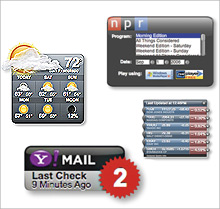 Want to build your brand cross-platiform but having trouble getting it to happen online? Widgets just may be your answer.
And it's cost-effective, too.
The Jointblog has been a longtime fan of widgets since first discovering Konfabulator in 2004 (later purchased by Yahoo! a year ago). With the release of Window's new Vista platform, PC users will get a whole new array of widget options (also known as "gadgets") for the desktop which will pull more Internet activity off of web browsers and onto these customized mini-applications.
Widgets were one of several great additions for Mac's OS X system, epecially for its Dashboard advancements for 10.3 and 10.4 in the last year (expect even more once Leopard 10.5 and the new iPhone are released this summer).
And Google already has invested deeply into widgets, too. In addition, as WiFi and WiMax helps make the web more accessible with mobile devices and cellphones, widgets will be the key killer app to make the web tolerable to use when mobile.
It's the perfect bridge technology bringing "old" media into the new media world.
Business 2.0 said "suddenly everything's coming up widgets." In November, Newsweek proclaimed 2007 to be the Year of the Widget and we couldn't agree more. Last month, West Coast wireless carrier AllTel previewed its new widget-handy cellphone tools and received rave reviews for it at January's CES.
Most powerfully, these widgets create focused user experiences giving exactly desired content immediately, on-demand, 24/7, when the user wants it.
For content owners, it also provides an advertising opportunity that can be built right into the widget app.
It's the media trend the Jointblog continues anticipating to grow in significance.
The big question: will traditional media sources such a radio, TV, newspapers and magazines be too slow to notice or will they see the low-cost, ease-of-use opportunity in time?
If radio could figure out its DRM and AFTRA issues, it could create the perfect bridge to build fast online tuning. For example, RadioSherpa's radio badges.
What's going on with your radio station this week? On your morning show? Latest contests and promotions? How about for your market's entire cluster of radio stations? It can all be done on one widget you build. Auomatically, through RSS and other feeders.
Nice and easy. For you. And, more importantly, for your listeners' digital online needs.
Good follow-up article: What's Up With Widgets?
For a quick review of why widgets matter now, here's a 2-minute YouTube/Engadget clip explaining the immediate value of widgets and why you should consider offering customized widgets for your own users to use, install and even embed into their blogs and websites (which, if done, can serve as a free form of marketing for you):
posted by Unknown @ Sunday, February 18, 2007,
,
It's about time: MTV/Viacom will make their video content available online -- on their own terms
Labels: Digital, Google, Jointblog, MTV, New Media, Viacom, Viral Video, YouTube After announcing earlier this month all Viacom/MTV Networks content must be pulled from YouTube immediately, there's news today that Viacom is prepping to make its videos available again to hundreds of thousands of other sites...on its own terms.
Not yours.
Meanwhile, YouTube doesn't care...as they take another step toward world domination as they go mobile.
Back to Viacom, according to Reuters:In the next few months, Web users will be able to grab videos from nearly all MTV-owned sites and post them on their own blogs or Web sites, lessening the need to go to YouTube, the top online video service that Google acquired last year.
MTV says they need to open their websites and content for consumers and for other companies. It's all part of a strategy to bring their sites up to what they call "Web 2.0 standards", allowing "people to take content and embed it to make their own things out of it."
Viacom, owner of MTV Networks and the Paramount movie studio, had been planning for this move months before it demanded earlier this month that YouTube remove more than 100,000 unauthorized Viacom video clips from its site, after failing to reach a distribution deal.
Yes, this is a move that needed to be done. But what took so long? Not to sound like a complainer or a told-you-soer...but why didn't MTV/Viacom do this two years ago? Why wasn't MTV the leader making this happen instead of being a long-asleep follower? Does MTV/Viacom really think web users, bloggers and media trend watchers won't see this as anything but manipulation?
With all the synergy of the Viacom/MTV Networks content umbrella (not to mention the CBS "Innertube" launch from a year ago), shouldn't this have happened long ago?
posted by Unknown @ Monday, February 12, 2007,
,
Google says Internet isn't TV
Labels: Cable, CES, Digital, Google, Internet, Jointblog, MacWorld, Media, New Media, TV, Yahoo TV is TV and the Internet is the Internet...but the differences between TV and Internet are getting more and more blurry.
You'd certainly see no difference if you went to last month's Consumer Electronics Show or MacWorld conferences, where the New York Times thinks the Internet is coming to TV.
High-speed broadband internet access is often bought from high-speed digital cable providers (who also sell VoIP)...so when we pay our monthly bill to just one provider, it gives the appearance TV and Internet might be the same thing.
View any late-night TV talk show and you'll see Leno, Letterman, Conan, Olbermann, Jimmy and Craig (and so many others) all making their own viral video picks found on YouTube.
If you read any interviews from AOL or Yahoo! execs over the past several years, you'll see a common theme describing the Internet as a new version of "interactive TV" and specific services they offer as "channels".
Internet access of audio/video programming through WiFi, WiMax, cellphones, iPhones and more.
So, aren't the Internet and TV becoming one-and-the-same? Certainly, they're sleeping in the same bed.
If 'a' equals 'b' and 'b' equals 'c', then 'a' equals 'c', right? Interestingly, Google, which acquired online video sharing site YouTube last year, says the Internet is not designed for TV, according to Reuters News.
It even issued a warning to companies that think they can start distributing mainstream TV shows and movies on a global scale at broadcast quality over the public Internet.
So why does Google say the Internet is not TV?"The Web infrastructure, and even Google's (infrastructure) doesn't scale. It's not going to offer the quality of service that consumers expect," Vincent Dureau, Google's head of TV technology, said at the Cable Europe Congress.
Hear that sigh?
Google instead offered to work together with cable operators to combine its technology for searching for video and TV footage and its tailored advertising with the cable networks' high-quality delivery of shows.
It's a collective sigh of relief from global TV broadcast executives finally hearing -- directly from Google -- that even Google sees limitations in their expanding empire. That TV will still keep its own platform. And that the Internet industry and the TV industry are capable of co-existing.
Does that mean they sleep in separate beds or in separate bedrooms?
posted by Unknown @ Thursday, February 08, 2007,
,
Instead of a SecondLife, why not Get a First Life
Labels: Alexa, Digital, GetaFirstLife, Jointblog, Media Trend Watching, New Media, Online, SecondLife, web traffic Last Fall, the online universe of SecondLife was the new media trend buzz. Now that more than 60% of Internet users at home log on through high-speed broadband, it seemed that a tipping point had been reached and passed. Brick-and-mortar business began buying real estate -- and even islands -- with their Linden dollars. People could meet and flirt (and even fornicate) with new "friends".
Suddenly, people could live a new virtual life.
Yawn. Many people found out having a second life can get too complicated. Or boring.
According to Alexa.com, SecondLife remains a popular web destination. But it's growth is slowing way down.
So what are people starting to do if they're not managing their SecondLife anymore. Perhaps revisiting their FirstLife again.
Oh yeah...the job, the family, the real things you're supposed to do.
Alexa says SecondLife is ranked #1,348 in total web traffic...still a strong amount of activity. However, its total reach has dropped significantly since its highest peak right after Christmas. Interestingly, the tongue-in-cheek website GetaFirstLife.com (with slogans like "Go Outside" and "Your world. Sorry about that.") is rapidly on the rise as Alexa's #2 "Mover and Shaker". It's rose 400% in traffic in the last week and now ranks #5,662 overall (up from 30,994).
No virtual life to live there...but you can get the t-shirt.
posted by Unknown @ Sunday, February 04, 2007,
,
John Parikhal on What if XM and Sirius do merge?
Labels: gadgets, Joint Communications, Jointblog, Karmazin, merger, New Media, Pinero, Radio, Satellite, Sirius, XM The merger speculative talk about a possible XM and Sirius merger continues to stay red-hot.
There are many pros (reduced operating and competitive costs, larger OEM relationship network, etc.) and cons (FCC opposition, less competition no longer contraining subscriber fees, incompatible technologies, etc.). The Street.com's Jim Cramer loves the idea -- while Wall Street continues to speculate.
If it happens, the deal will have to happen soon (within the next 6-8 weeks, and approved by company stakeholders by this summer) if it is to pass through all the regulatory hurdles before the 2008 elections.
Bridge Ratings just released their updated subscriber projections (assuming the two companies don't merge), anticipating a total of 35 million subscribers by 2020. Here's their provided chart: Both XM Radio's CEO Hugh Pinero and Sirius Radio's CEO Mel Karmazin publically say they are not exploring combining the satellite radio into one company. Of course, that doesn't cover any possible private conversations.
If the merge did happen, who would win?
Joint Communications' CEO John Parikhal shares his thoughts on a possible XM and Sirius merger: XM and Sirius have different programming philosophies. Sirius has more technical problems than XM. In a perfect world, XM would win.
But ... Mel Karmazin is a smart cookie. He's pushing for a merger to deflect the fact that Sirius is far behind XM. My bet is (I could be wrong) that he figures Wall Street will crown him to run any merged entity ... so he beats the merger drum.
Because ... XM has fumbled the marketing ball more than once. They have not created enough need. Which is what gives Mel his bully pulpit.
XM had a huge opportunity to grow during the early years of consolidation when the arrogant roll-up artists were bragging about how they could run 16 minutes of spots an hour on music radio. Where was XM with a "commercial free" ad campaign? Instead we got stupid TV ads with David Bowie crashing through the roof.
XM still shies away from "commercial free" music with lots of choice, choosing to promote second tier programming that has big names but little that is fresh or new. And ... much of the "talk" and news programming has commercials!! How many people are going to pony up $14 a month for Oprah's sidekick (Oprah is not really Oprah) or to listen to a golf match.
XM lost the chance to cripple if not kill Sirius when it raised its price to $14 a month from $10. They could have clobbered Sirius (before they hired Stern) by focusing on what a deal $10 a month was compared to Sirius $14.
Having said all this ... there's still a good business in satellite radio. There is a real market of between 20 and 25 million people for the product. It will coexist with terrestrial radio just as cable coexists with network.
Both companies need to focus on marketing, not personality stunting, if they are going to get the respect they deserve. They might take a page from the old Rolls Royce advertising strategy - who focused on those who already bought a Rolls - "reminded" them of how great their car was - tried to make others envious - used "emotion" to create the need.
posted by Unknown @ Saturday, January 27, 2007,
,
Bumps and Crashes: Slick New Media Watching
Labels: Jointblog, Media Trend Watching, New Media, Slippery Slope, Video, YouTube New media is slick. Sleek. Slippery fast. It changes our point of view of media and the world around us.
Change can happen so rapidly, it seems we slide onto the next-new-thing right away. Faster and faster. The loss of control as users decide how, what, when and where they use new media has content owners feeling out-of-control, with nothing slowing it down.
No brakes. No steering.
Kind of like watching this YouTube video of driving conditions on a hill after a Portland ice storm. The literal slippery slope. Careful: there are bumps and crashes ahead. The good news: some damages are repairable. Even so, some are not.
Change can be a slippery slope...slippery slopes do eventually reach an end point.
Where will new media take us next? And how can we steer clear of obstacles?
That's for media trend watching...
posted by Unknown @ Sunday, January 21, 2007,
,
Mobile WiFi Radio: What Radio could look like soon in a city near you
Labels: Clear Channel, Digital, eChannel, Internet, Jointblog, Mobile, New Media, Radio, Teens, WiFi, WiMax, Wireless Broadcast radio began ignoring teens right after Baby Boomers finally moved out of the demo 20 years ago. The only rare exception was the short-lived Alt Rock boom during the Grunge 90s. Yes, Top 40 radio still attracted teen listeners (what choice did they really have?). But, for the most part, radio strategically decided it needed grownup listeners in order to maximize revenues.
Teen radio listeners were accepted by default. Secondary. Most often, teen ratings have been viewed as a negative for a long time.
The rise of the Internet, file sharing, iPods, and Internet radio easily and quickly filled the void created by radio station ignoring teens. Now that the World Wide Web is 15 years old, an entire generation has grown up relying on the Internet, not radio.
What can radio do to begin connecting with current and future teens? And what do teens want?
Well, to start, radio can start appreciating, targeting and programming to teens. But, to do so, it needs to deliver ("broadcast") in a manner teens listen to their modern definition of "radio".
For teens, radio is a digital experience -- fluid, listened to in multiple formats, on multiple devices, time-shifted whenever they want to hear it. Radio was the original "wireless". Today's teens think of "wireless" in a completely different way. Wireless means something to communicate with -- cellphones, texting, emailing, WiFi, WiMax, Internet-based, fully digital and fully listenable on any and every digital device they own.
Last September, Toronto became one of the first major cities where a major radio broadcaster launched a new radio format available not over the old airwaves...but through the Internet to be heard on the new free city WiFi services.
Here's another new example of what radio could (and should) look like in cities everywhere, as reported in InsideBayArea.com:If a radio lover were featured on MTV's "Pimp My Ride", his or her car would look very much like the two Scion xBs that Clear Channel's new eChannelMusic was showcasing around San Jose earlier this week.
Attitude. Mobile. Edgy. Street.
These were rolling radio stations, although they never use the word "radio". They were WiFi Internet stations, programmed partly by listeners at www.echannelmusic.com with video screens, blaring waterproof speakers running 24/7, and a computer keyboard and screen and a large microphone in the back seat, from which street DJs could do commentary.
The $40,000 rolling studios are the first stations that the large Clear Channel radio company was programming without actual radio signals.
Remember when radio knew how to do that?
posted by Unknown @ Sunday, January 21, 2007,
,
Brand Advocates Online: They tell a friend, who tell a friend, and so on...
Labels: Advocate, Branding, buzz, Jointblog, New Media, trends The explosion of social networking sites defines today's Web 2.0. How do these online gathering places get popular? According to a new research report by Yahoo! and comScore Networks, it only takes a few key vocal individuals to spread the word.
Turns out it's exactly like that famous TV commercial for Faberge Organics shampoo from the late 70s (yes, with Heather Locklear): "If you tell two friends...they'll tell two friends, and so on..and so on...and so on..."
MySpace first friend (and co-founder) Tom Anderson is a prime example of how "pass it along" online recommendations work...at least among his 139 million "friends". Dubbed "Brand Advocates", these online consumers spread opinions via word of mouth, as well as over social networks, instant messaging, chat, photo sites and blogging. Such advocates have at least a two-to-one rate of converting a "friend" to buy the same exact product or brand they support, according to the report.
These advocates serve as online megaphones allowing advertisers to reach larger audiences.
The study found that Brand Advocates are slightly younger, more educated and spend more time online than do non-advocates.
They conduct an average of 48 searches per month, compared to 39 searches for non advocates; and 76 percent of advocates use search engines to research products prior to making purchases, compared to 64 percent of non-advocates. The more time and effort these advocates put into their own decision making process, the more they talk about their purchases with others. The study also found that advocates are generally positive in their opinions, with not much bad mouth-mouthing. It says 60 percent of advocates believe that good brands are worth talking about versus 25 percent of non-advocates. Advocates also spend their time promoting a brand more often than negating it, and approximately 90 percent write something positive about a purchase they made.
Another study clarifies "younger" for these Brand Advocates, stating that 40- and 50-something female Boomers are the Advocates spending the most time making recommendations to their friends and the online "friends".
Apparently, they took those shampoos ads to heart.
posted by Unknown @ Tuesday, January 09, 2007,
,
Custom Cellphone Wallpaper...Cool!
Labels: Audience, cellphone, Cool Idea, customizing, Jointblog, Logo, New Media, wallpaper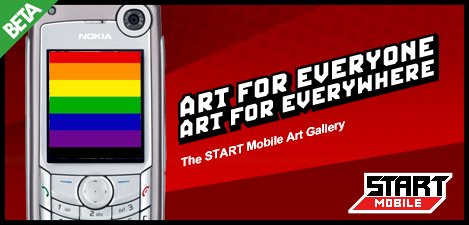 OK, anytime we bump into a claim for 'world's first', our media trend watching radar perks up. If you're looking for a cool idea, how about this...
Custom cell phone wallpaper.
San Francisco's START MOBILE, a gallery selling art for cell phones. Part of the START SOMA gallery, the venture sells thousands of original works of new art from hundreds of established and underground artists, to be downloaded onto mobile phones. Wallpapers are billed $1.99 USD, with the artist receiving a small cut.
Cool Idea: If you are in media, why not contact Start Soma and have their artists put a pop culture spin on your logo integrated into art for your audience's cellphone? Or, better yet, set up an affiliate marketing relationship to help sell the cellphone wallpaper artwork through your company's website, where you pick up a small cut for each transaction driven through your website. Good for your NTR initiatives.
posted by Unknown @ Sunday, March 12, 2006,
,