

Screw You Recession: Using Social Media With Brands -- Virgin Mobile
Labels: blogging, brand building, Connection, Consumers, Content, Marketing, Mood Meter, social media, Twitter Traditional brands have had a hard time figuring out social media. They are used to old marketing models where they keep firm control of the message.
Create a brand phrase or concept and then repeat it millions of time on whatever media platforms, getting as much exposure as possible. The adage "If they say it often enough, it must be true" has been the prevailing wisdom for decades. The hoped-for by-product? "Gosh, if they are willing to spend so much money to tell me something about their product, it must be true...so I'll buy it."
All the traditional ad markets have softened: TV, newspapers, radio, magazines. And the projections for the next few years look tough.
For decades, consumers have been sold, pitched, cajoled, and almost guilted in buying products through the magic of marketing and advertising.
Why are the ad markets hurting? Psychologically, making a purchase satisfies many possible things: taking care of a need; a want; a desire; or for preventing something they fear. That is no different today than from previous generations. Traditional media still "sells" needs, wants, desire and fear-fixers.
It's just that today's consumers want more than simply being told to buy something before they make a purchase.
They want to engage.
They want to hear from other consumers to validate their own thinking about the brand choice.
They want their own voice heard.
So far, traditional brand marketing has been slow and inconsistent in its success using social (or user-generated) media for marketing.
Remember the user-generated Dorito's Super Bowl TV ads?
What about the GM's Chevy Tahoe SUV ad contest?
Just in the last few weeks, Skittles set the Twitterverse afire by changing their main brand homepage to their Twitter profile, then to their Facebook profile. To help their customers "Interweb the rainbow", users create custom "garageband-like" audio themes using various Skittles audio clips. What did it get them? Lots of social media hype, more than 630,000 Facebook friends (M&M's Facebook site only has 25,000 fans)...and an increase of their web traffic by more than 1,325% the first day it launched the campaign.
So can a brand do well by saying "Screw You, Recession"? One is trying...and using social media to do it. Here's a site blending social media merged with an established brand. Go to ScrewTheRecession.ca/ and it comes from the new thinkers over at Virgin. Virgin tends to embrace marketing experiments; I think it's worthwhile to check it out. Tying in recession concerns with younger people, it's a blog with a heavy user comment section, simple Virgin Mobile advertising and various topics sections on money, living, fashion, going out, tech and more. Plus they Twitter and Facebook it tying it together.
The impact: How can you (the consumer) screw the recession? You need your cellphone. Screw the recession by using a Virgin Mobile cellphone.
They've done some cool research through the site on their users.
As reported this week in Virgin Mobile press release of their JD Power study:
The only thing they miss is not tying it into their Virgin Radio sites. It's a natural partner. "Virgin Mobile Canada has created a mood meter that ranges from "Everything Sucks Huge" (red) to "The Recession Ain't Getting Me Down" (green). The five-stage colourcoded system shows that – this week – young Canadians are on Yellow Alert ("Sorta' Freaking Out Right Now"), which means:
* Biting nails - 72% are anxious about their future
* Brand disloyalty - 41% have given up a brand they love
* Show me the value! - 52% are open to trying value brands
* Chic-onomics - 88% have changed their shopping habits
* Recessionistas - 42% are making "noticeable sacrifices"
* Unemployment - 42% fear being unemployed
* Politics - 57% say they don't believe a change in government would change anything
* The Simple Life - 75% want a simpler life.
The Mood Meter looks exclusively at the impact the recession is having on young people's (17-35s) lives, how they're feeling about the state of the economy and what the recession means to them. It's also a barometer of their thoughts and shopping habits, as well as their feelings on how brands are behaving. See Virgin Mobile’s www.screwyourecession.ca."
Cross-platform connection on contemporary consumer demands, needs, desires or fears...with the consumer front-and-centre contributing and sharing the content.
The audience (listeners/customers) are the drivers...all we in media have to do is provide the proper vehicles for them to get where they want to go and what they want right now.
That's how brand marketing can use social media to its advantage.
posted by Unknown @ Friday, March 20, 2009,
,


Tribes and Brand Building...Plus Seth Godin about Twitter
Labels: brand building, Customers, Marketing, Purple Cow, Seth Godin, social media, TED2009, Tribes, Twitter Twitter just jumped its total number of users in the last couple of weeks -- from 6 million to 8 million -- due to more mainstream media coverage (The Daily Show, morning radio shows, newspapers, many others). Leading "Tribes" maven and Senior Purple Cow Seth Godin refuses to tweet. To find out why, go to the 9:15 mark of this Ted 2009 conference interview (February 5, 2009):
Whether or not you use Twitter, social media needs to be part of your modern marketing plan. To marketing messages to have impact today, they need to feed into consumer's needs for convenience, connection, community and control. They want to be fans and to share through positive word of mouth. The key is provide content for your brand's most passionate users to help spread the word and praise.
That's how you get customers in your store today.
Marketing Sherpa says in a recent survey that over 90% of companies believe social media is most effective in building brand reputation and awareness, with direct marketing objectives falling into the second tier expectations.
Spotting upcoming social networking trends is important in the world of word-of-mouth campaigning. Brand enthusiasm is an essential ingredient when building brand awareness. It immediately has the strongest potential of converting into sales and extended customer loyalty.
Just as Seth Godin believes. You may not see him posting Twitter...but, believe me, he loves seeing his fans tweet about him and his books.
Hey, if you are a fan of this article, tweet it!
posted by Unknown @ Wednesday, March 11, 2009,
,
Googling You and Me
Labels: brand building, Chris Kennedy, Findability, Google, micro-blogging, Reputation, results, social media, social networking, Twitter With all the talk about social media and micro-blogging, Twitter is catching a serious amount of online buzz as being the new tool for the next level of search: "real-time, conversational search".
It's great to have those you follow help you scour the web for news that matters and is customized for your needs. Will it only get more important in the next stage of web search development. Absolutely yes, especially when it comes to super-serving your "audience" and for overall web brand reputation building.
That being said, findability is still the most important aspect of search and online brand building. If you can't get found, your fabulous content ain't going a whole lot of places.
Google remains the 800lb gorilla of search...and it has no plans of releasing its dominance.
For the Jointblog, we are #1, #4, #6, #9 and #10 out of 29,000 webpage Google results.
For Media Trend Watching, the Jointblog is #2, #7 and #9 on Google out of 56 million results...need to get it back up to #1!
What about Chris Kennedy radio trend? As the editor of the Jointblog covering radio trends as an important subject, I'm very happy having all Top 10 first-page results on Google out of 60,000 results -- including my Twitter @KennedyCS for following.
Or just Chris Kennedy radio? Google shows we have #1, #2, #7 and #10 -- all on the first page, among 513,000 results.
Even just Chris Kennedy trend works on Google, where I am #1, #2, #3, #5 and #7 on the first-page out of 214,000 Google search results (again, Twitter shows up).
But just Chris Kennedy? Only #2 on the second page of Google out of 12 million results for posted articles from me...and #39 (page 4) for my LinkedIn profile. Need to use social media more to build up organic search results.
Using other search engines for Chris Kennedy Radio, Clusty has me as #1, #4, #5 and #7 on first-page results. MSN's Live Search, meanwhile, lists me as #1, #3, #4 and #10.
Looking good!
Getting to the top of the first page of Google organic keyword search results still is essential in order to reach your target.
When you google yourself or your company or your targeted interested, what do you find? Have you googled yourself lately? If you're not get the SEO results you need, what are you doing to fix the result?
Interestingly, using those social media and Twitter micro-blogging can help boost you to the top of the page.
posted by Unknown @ Friday, February 27, 2009,
,
A Good Sign for Future CBS Radio Growth: Bringing Dan Mason Back
Labels: brand building, CBS Radio, Change, Dan Mason, growth, Media Trend Watching, Move Forward, Sirius, Stern, Traditional Media Experience from someone who's been there is a tremendous asset...especially after having a chance to step away, learn and view changes impartially for a fresh perspective.
CBS Radio needed fresh prespective.
CBS Radio needed fresh leadership.
CBS Radio needed "been there" experience from someone who knows how to get "it" done.
And CBS Radio got it.
Bringing Dan Mason back to CBS Radio looks like the right decision. CBS Radio's 7% drop in year-to-year revenue for 2006 was a direct end-product of industry, listener and customer perceptual losses in branding trust.
How?
From bold format changes across the nation (in the spirit of innovation) that failed to connect with new audiences.
From poor decisions handling the entire Howard Stern transition to Sirius satellite radio, messing up millions of listener's morning routines...especially after CBS Radio tired to fill the programming vacuum unsuccessfully.
Worst of all, from breaking "brand trusts" with listeners through perceived manipulation...and not delivering better products; the quality level of radio stations CBS Radio listeners have long expected from CBS Radio.
This change is an important step in rebuilding trust.
Before they brought back the CBS Radio name, they were Infinity Broadcasting -- the company that invested in radio's best talent, best programming, best leadership, best sales teams, the best radio market's. Before Infinity, it was Westinghouse. And before Westinghouse, it was CBS Radio.
CBS Radio has long been radio's crown jewel...with the exception of the last few years. Perhaps it is coincidence that CBS Radio's performance and perceptions changed after 2002 when Dan Mason "retired" to begin consulting. Perhaps not. Perhaps CBS Radio was just a victim of traditional media losing out to new media. Perhaps not.
The fact Dan Mason is coming back is a good sign for returned CBS Radio growth. Dan's been there. He'll debunk myths and move the group forward. He knows what it felt like within Infinity during its "championship" years, its legacy years as radio grew through the 70s, the 80s, and the 90s. And he's largely consulted new media (such as Sirius) through SaboMason since leaving CBS Radio/Infinity in 2002 (while also consulting CBS Radio).
One of Walter Sabo's respected strengths is his passionate viewpoints on creativity for radio, regardless of format. No doubt CBS Radio will benefit from Dan's recent experiences with Sabo.
New ideas and fresh perspective to the table...while also bringing "been there" assets.
Things seem to be looking up for CBS Radio again. And that's a good thing for all of radio.
posted by Unknown @ Tuesday, March 27, 2007,
,
Brand Building: The Seven Essential Connections
Labels: brand building, Branding, Customers, Jointblog, Marketing, Seven Essential Connections, X Factor New media has shifted marketing perception suggesting the rules for brand building have dramatically changed.
Actually, the rules haven't changed -- and neither has the end goal. Rather, it's the methods and choices used to build those brands that have changed the way brands are marketed, with some new powerful tools gaining popularity and other previously-strong tools losing power (or already lost it).
Here's what remains as true and essential today as always: for significant and meaningful brand building connections and branding engagement, brands have to share common ground with the desired customer.
What does this mean?
The relationship between brand and customer must represent something real to the customer; otherwise, the brand doesn't matter in the customer's world. Miss this connection and you certainly won't motivate brand advocates.
Successfully-built brands have to be genuine and based on the real values and vision of the brand. Larger brand audiences and market share dominance happen when the brand links distribution of the brand intention with the brands perception. It's the bedrock of trust and common ground, allowing the relationship between brand and consumer to grow and prosper.
What are the Seven Essental Connections for Successful Customer Brand Building? The brand MUST share with the customer:
1) Life values (self-identity)
2) Core "roots" (history, heritage, religion, etc.)
3) Cause (forward-moving purpose)
4) Mutual interests and/or benefits (time spent together)
5) Lifestyle (community)
6) Hobbies (interactivity)
7) Preferences (like and shared dislikes)
Brands that connect with customers on all seven levels consistently are engaged. And yes, bottom line results are important just as it is for owners with brands not fully engaged . Look at some of the biggest successes: Apple, for example. BMW and Toyota (including the new Scions) for cars and Ford for trucks. Even TV shows like American Idol, Lost, Heroes, 24, The Daily Show and The Colbert Report. Each connect on all seven levels...and deliver financial results and customer buzz.
But not all brands connect on all seven levels.
Why not?
Most brands don't consciously concentrate on servicing, staffing or budgeting the brand on those 7 levels. Which is too bad; if they did, the brand would earn the cherished "X Factor"...that special extra oomph in brand value making it superior than any competitor.
How well is your brand connecting?
posted by Unknown @ Monday, March 26, 2007,
,
Findability: $10 Billion Spent on Search Marketing in 2006
Labels: Advertising, brand building, Findability, Getting Found, Google, Internet, Media Trend Watching, ROI, search, Search Marketing, Yahoo Natural organic search is the most essential way to get found on the Internet. Websites not listed on the first page of Google keyword search results always generate sub-optimal traffic. Get found on that first page...and your desired brand advocates will respond.
Of course, getting to #1 is most desirable.
More and more, the corporate world seems to be understanding the importance of search marketing. That's a good media trend to watch, as these investments are already beginning to deliver strong ROI results.
According to an annual survey conducted by the Search Engine Marketing Professional Organization (SEMPO) relased last month, advertisers in North America laid out close to 10 billion dollars on search engine marketing in 2006 -- a 62 percent spending increase versus 2005. SEMPO found that based on its survey of 587 search agencies and advertisers, the amount of $$$ spent on search marketing will double by 2011, reaching $18.6 billion.
These figures include both paid search advertising and spending on internal search engine optimization.
The report says Google dominates the search advertising business. Among the marketers and agencies surveyed, 96 percent of them report using Google AdWords to promote their brands.
Yahoo! also does well, with 86 percent usage among search marketing budgets...
Meanwhile, less-used (and therefore less-cluttered) MSN, which has long struggled in a distant third-place position in the search race, has made great strides among advertisers, with 68% of advertisers saying they used MSN for their search campaigns in 2006, up from just 29 percent in 2005.
Key area for growth in search marketing: Brand Building
Search advertising for brand advertisers is still a less-than-mature growth category. Despite claims that more and more brands are using the Internet for branding, just 21% of search advertisers actually track or measure the branding impact of search for their campaigns.
Long Tail thoughts here
Brand Building: The Seven Doors of Connection here (pdf)
posted by Unknown @ Monday, March 05, 2007,
,
USA Today Gets Makeover, Redesigns Website
Labels: Alexa, brand building, Branding, Buzzmachine, Change, makeover, New Media, redesign, USAToday USAToday's online version of its newspaper -- USAToday.com -- has been one of my old reliables on the Internet for years. With new websites constantly popping up trying to get popular attention, USAToday.com has been like web comfort food for millions of web users.
Always reliable. Always there. Colorful. Easy to find and digest top mainstream news and pop culture stories. Just the right amount of news to give readers an idea of what's happening today in the USA.
Just like their newsprint version.
That's their brand online, too.
Or, it has been, up until USAToday.com's new "makeover" this weekend.
Change and the Internet seem to go hand-in-hand. Change is inevitable in business. Like yesterday's Jointblog posting, you have to find ways to "move forward". Which is what USAToday.com is doing...moving forward to something they call "networked journalism" (a concepted apparently created along with BuzzMachine's Jeff Jarvis).
According to USAToday, this new design will allow readers to comment on every story on the site, create profiles and blogs, upload photos and interact a lot more.
Here's their official announcement:Big changes are coming to USATODAY.com. Starting this weekend, you'll have more interactive opportunities, see a dramatic new design and find a new way of thinking about the news.
Why the change? It's not like USAToday is also changing their newsprint editions. Their previous online versions were designed to look and feel just like their newspaper. Not anymore. Perhaps that the point, considering the overall newspaper industry's long, slow decline: change to read less like their newspaper and more like online readers.
USATODAY.com's aim is to create a community around the news, one that connects readers to reporting. In its 25 years as "The Nation's Newspaper," USA TODAY has always tried to listen to a variety of readers and understand what's important to them. As the next logical step, we're building the nation's newspaper into the nation's conversation....So, watch the site. Change is coming, and you can be a part of it. (click here to read the rest of the USAToday announcement.)
For years, "The Nation's Newspaper" has served its brand function with excellence in this noisy, distracted mediaworld. It's fast, colorful and easy to read, perfect for commuting on the train or the shuttle flight (or even extended reading on the toilet -- come on now, admit it). And USAToday.com became one of the top websites in the world, built on the same principles: fast, colorful and easy to read. Something you'd want to check out everyday. Sometimes several times a day. In the past year, web traffic has gone down, according to Alexa (see graph). Which, ultimately, must explain why USAToday is making a change. However, I still don't get the reason for their change. It doesn't make sense. Despite some traffic drop-off, they still are the 525th most-trafficked website in the world!
March 5th update: Looks like the public is giving a collective "thumbs down" as of Day 3 since the changes. USAToday.com has slipped down to a one-week average of 649 most-visited in the world...and down to 856 for yesterday. What will Monday rankings look like when they are updated on Alexa tomorrow?
Now they've done a makeover...and, as a consumer and a media trend watcher, I'm less than pleased with the results so far.
Even on my high-speed broadband, this redesign is clunky and slow-loading for all the graphics and code they've packed onto their pages...including most crucially their homepage.
Is a makeover really going to bump up that traffic ranking when they've just made their site's usage more difficult?
I'm sure there are bugs and fix issues to work out. Change and moving forward is important and needed. And sometimes it is unavoidable. If you must change, protecting the brand still remains critically important. And ideally, the changed user experience will prove better.
Right now, I have to wonder: Is USAToday.com now trying to be a brand they're not?
posted by Unknown @ Sunday, March 04, 2007,
,
Lessons in Customer Brand Building
Labels: Advertising, Apple, brand building, Branding, Coca Cola, CRM, Customers, Truthy
 In brand building, do you:
1) Teach with facts (without emotion, except perhaps subtle guilt or "do this now" commands)?
...or...
2) Promote with truthiness (with twisty wordplay of "wishful" results, even if unlikely)?
...or...
3) Create product/customer relationship opportunities (allowing the consumer to attach their own aspirations and value)?
Successful brand building is more than just associating a product with a brand message. Successful brand building results occur when a customer associates a product with a brand message...and agrees that union has continued value and meaning to that customer. iTunes, the iPod and "Hello I'm a Mac" MacBoy all are extensions of Apple's "Think Different" brand building proposition led by Steve Jobs...attracting loyal fans who love the product and love being associated with the product.
Coca Cola has been "The Real Thing" for 80 years, even while they tried to teach the world to sing.
What is your primary brand message doing for your customers: teaching, being truthy or creating relationships?
Have you media trend watched today?
posted by Unknown @ Saturday, March 03, 2007,
,
Plan "Opportunity" into budgets, like Hot 99.5 with Bobby Brown
Labels: Bobby Brown, brand building, Branding, Budgets, Hot 99.5, Meltdown, Opportunity, Radio, Scandal For right or wrong, the media loves to exploit celebrities...and, for the most part, celebrities (plus their publicists) love it, too. Look at all the major celeb meltdowns we seen in this post-YouTube, post-TMZ era. Paris Hilton. Mel Gibson. Tom Cruise. Michael Richards. Nicole Richie. Lindsay Lohan. Grey's Anatomy's Dr. Burke. Britney.
Media watched, gawked and mocked as one PR crisis after another drove ratings, web traffic and headlines.
Bobby Brown is the latest notorious celeb in trouble. This time, instead of the media just piling onto the celeb's scandal, a radio station has stepped up and given a helping hand.
Hot 99.5 in Washington, DC paid his bail (getting him out after a 3-day stay in lock up) as well as his overdue child support payments to the mother of two of his kids born prior to his marriage with Whitney Houston.
In exchange, Bobby Brown will co-host with Kane during the morning show on the rhythmic hit station, putting him to work for his money. It also gives Brown a chance to air his version of the events, entertain, be the spotlight and say any mea culpas he wishes to give.
The by-product?
Massive worldwide publicity references on the entertainment and late night TV shows, cable network newscasts and talk shows, other music and talk radio stations, newspapers...and, of course, the Internet. And now it's a front webpage web event for Hot 99.5.
Radio station's MUST get back to budgeting a line item called "opportunistic marketing fund". It's a forgotten (but still valuable) brand builder. Planned and budgeted marketing dollars kept ready to use for the station to do good works in the community, creating positive goodwill (and potentially far-reaching word-of-mouth marketing buzz).
Trying to suddenly find $$$ in tight budgets for the station to respond to sudden "opportunities" (as Hot 99.5 has done with Mr. Prerogative) is minimally complicated and difficult. Usually to the point where nothing happens and the opportunity is lost.
Build "opportunity fund" mechanisms into your budgets and explain it to the controllers what that means. And then wait for opportunities. Don't worry...you won't have to wait very long.
After all, celebrities will continue to meltdown...
Just don't forget to put out the press releases and viral video.
More melting down" update (3/2): But will Bobby Brown back out? Update (3/5): Yep, he's out. Even so, Hot's effort was worth it.
Always the drama...it's not easy Being Bobby Brown...
posted by Unknown @ Friday, March 02, 2007,
,
Favorite TV show viewing: Using Internet as TiVo
Labels: ABC, brand building, Information Superhighway, Internet, Jointblog, Media Trend Watching, NBC Rewind, streaming, TiVo, TV, VCR, Video player, Viewing The Information Superhighway keep winding and twisting. Lately, I wonder if it's becoming the new TiVo.
My TV viewing schedule has been messed up -- again. Like most people, I no longer am held captive by just a few channels. I bounce all over the place: different favorite show on a different channel on different hours. I rarely keep the TV on the same channel for back-to-back shows (same thing for my teenage daughter).
Some things are an absolute must. 24 Monday night at 9pm on Fox -- a must watch. My friends know not to call until after it's done. Heroes is another must watch -- but it's broadcast on-air at the same time as 24 on NBC.
So what do I do?
What about Wednesday nights at 10pm now, when Medium and Lost air at the same time? Or Thursday night's 9pm block, when Grey's Anatomy squares off against NBC comedies? Or when I simply don't have the time to watch at all? I never use my VCR -- gave up using that wasted old tech device a long time ago. I don't watch or care enough about TV to have a TiVo either, even for my high-def big screen.
My solution?
Same as it's been for millions of people. The Network's online streaming sites, especially for ABC as well as NBC's Rewind. The Internet is quickly becoming the new personal video player. And it's helping the TV networks build their brands online.


ABC got off the block first streaming full episodes almost a year ago a little roughly...but it has gotten much better since then. Fewer streaming dropoffs and more shows to watch. And far fewer commercials than what you'd see during a TV broadcast.
CBS launched their Innertube last summer while NBC waited to launch their full episode site in October -- last among the Big Three networks.
In my humble opinion, despite being last in, NBC's Rewind service is far better than either ABC's or CBS's service. Already, NBC's Rewind has delivered 42 million full show viewings.
My personal rankings:
#1 -- NBC
#2 -- ABC
#3 -- CBS
A new Mediaweek article reports that many are using the Network streaming sites just like I'm doing: as their personal TiVo. Just look at these just-released results for NBC:> 78% of users who streamed full-length episodes watched shows from the series they usually watch but missed on broadcast television.
This is a huge result. As a viewer, I say thank you broadband! The Internet is quickly becoming my personal video player. This model makes sense and is one to watch as a media trend.
>81% of those surveyed said they recalled specific pre-roll ads -- using single sponsors for entire shows playing only one commercial per break certainly helps make for powerful recall.
>26% said they viewed shows they had already watched on TV for a second time.
>34% said they used the site to preview shows they had never seen before.
I know I am.
posted by Unknown @ Thursday, February 15, 2007,
,
What is Net Neutrality? A Battle for Content Control
Labels: brand building, Jointblog, Net Neutrality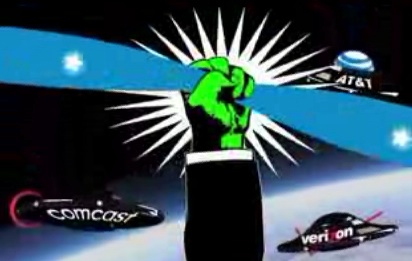 Net neutrality to save the Internet remains a hot political and media trend watching topic. Right now, the web remains "neutral"...open to all who choose to access it, allowing content to be freely and naturally distributed -- uncensored, without corporate influence controlling what you see, search or find. Natural organic search results are based on search engine algorithms measuring content authority value matching keyword terms.
Time magazine (and other mainstream publications) says 2006 was the first time user-generated media trumped mainstream traditional media in this week's "You are the Person of the Year" issue. Big Media Owners, though, are vigorously trying to figure out better ways to capitalize the Internet, as paid search, banner ads, subscriptions and general advertising models can produce only so much potential revenue.
For the past couple of years, some global media pipelines (cable companies, phone companies, broadband providers, etc.) have been pushing Congress to change the Internet's "net neutrality" laws. Big Media hopes to create a "tier" system -- creating a basic access level and a premium access level.
This would mean some Internet content potentially could be no longer part of the Internet's "public domain". Depending on how much you pay might determine how much access to the Internet you have. This has many social and ethical ramifications.
If allowed and enacted by Congress (which tabled the issue last summer), an Internet no longer neutral could also dramatically impact the entire concept of this Web 2.0 user-generated content era. It's a battle of control between Media Owners and Media Users...the most-important on-going media trend to watch in the New Entertainment Ecomony. With issues like copyright infringement, illegal download file sharing and Hollywood gossip blogger Perez Hilton, has any industry ever encountered a set of strategic choices more fraught than the ones the media business confronts today?
Despite the challenges, keeping the net neutral is essential.
This YouTube video shows how you can Save The Internet and keep it "net neutral".
posted by Unknown @ Tuesday, December 19, 2006,
,