

Transitions in Media Trend Watching
Labels: Being digital, Business, Chris Kennedy, Digital, Digital life, Joint Communications, Jointblog, Media Trend Watching, Parikhal, Radio, Transitions, trends Recently, the Jointblog passed 500,000 total page views to our site – and we are less than 3 years old. It’s hard to believe that our site is older than YouTube.
This blog was started and developed by Chris Kennedy as a way to focus on Media Trend Watching – a core competency at Joint Communications.
It surfs the wave between pop culture and business insight, a world of instant fame or shame where old media power is challenged by new media behaviors. There’s never a dull moment.
After working with me for over 15 years, Chris decided to return to his first love -- radio -- joining Corus Entertainment, a multi-media leader in old and new media, as Program Director of Montreal's Q92.
Chris has kindly agreed to continue the Jointblog so that we can keep an eye on media trends – big or small - from NBC’s rearguard action against Apple (refusing them content) to YouTube’s unpredictable effect on the upcoming Presidential elections.
And, the most significant trend we’re watching right now is the digital divide – the gap between those who are online (especially with high speed connections) and those who aren’t. America's lagging behind many developed countries in broadband per capita, including South Korea and Iceland.
The beauty of today's digital world means Chris and I will maintain our high-speed association with one another -- efficiently transitioning us from the Joint connection to a new digital connection.
posted by John Parikhal @ Wednesday, September 05, 2007,
,


The Joys of Drawing With MS Paint?
Labels: applications, brilliant, Digital, freeloveforum, geeks, Humor, MS Paint, satire, software, Spoof Some Sunday funnies for you...just found this wacky satire from freeloveforum reviewing the joys of MS Paint, where apparently the world is turning digital, the future is now and the future is in the past at the same time. In case you'd like to catch up, consider the amazing MS Paint to help get you there (tutorial here).
How? Make sure you follow that squiggly-drawn circle you draw with your mouse. Really! Or simply use that fancy erase tool if you get lost and start again.
Brilliant!
The media trend? User-generated viral video content -- especially ironic humor -- remains frequently smarter and more funny than what we get from TV.
posted by Unknown @ Sunday, August 19, 2007,
,
Connecting Radio To Digital Music Fans
Labels: buzz, community, Connect, Digital, Internet, Music fans, music sales, Radio, social networking, User-Generated, Web 2.0, webart Music fans are passionate. They talk music. Download, upload, swap, and playlist music. Participate on and start their own fan sites, go to shows, create/buy custom cellphone ringtones and fan wallpaper, serve as street marketers building up the buzz, blog it, and more.
These are great days for interactive music fans ...radio, are you listening?
They live the music of their favorite bands everyday.
Remember those days, Gen Xer? Sound familiar, Boomers?
Despite all the doom and gloom of industry indicators (album sales, retail sales, ticket sales...all down 15-20% from a year ago; weak debuts on the charts that don't stick; weaker TV ratings for music programming; etc.), there never has been a better time to be a Music Fan.
Radio is still figuring out how to connect with them. Some in radio are getting it, many others aren't.
What do teens want?
Radio has to program better to young music fans.
Radio has to understand their language, their various cultures. Value them. Be a place to connect with other like-minded people.
Radio can still do it.
Radio has always been an important social gathering filter. The "secret language" of rock n' roll delivered through transistor radios creating generation gaps between teens and parents back in the '50s and '60s is exactly the same kind of social networking we see today. Only now, it's through digital communication using multiple gadgets and devices in more interactive ways.
How will radio deliver more interactive opportunities for its listeners to form fresh social networking communities?
I stumbled upon this digital artwork (above) from a music fan in Germany. It's a great way to express creativity and be a fan, sharing it with the world.
Music Radio Website Idea: Create a custom digital webart community for Music Fans to express their creativity...it's a great way to participate in youth culture, acknowledge their contributions and connect with their music passion...the very essence of your music format. Then, convert the listener graphic art into a station/artist music gateway, where users/listeners simply click on the artist name -- leading music fans deeper into the site, allowing the radio station to showcase the music.
And be a music fan, too.
posted by Unknown @ Wednesday, April 18, 2007,
,
Viewpoints on HD Radio: Where's The Buzz?
Labels: broadcasters, buzz, competition, Digital, HD Radio, high def, NewMedia, viewpoint As a new media consumer product, HD Radio remains mostly "unheard".
Research reports awareness to be "up"...but consumer buy-in is still low, waiting to catch fire.
The buzz -- so far -- is not exactly "high def".
Sure, the announcement earlier this month that Wal-mart will start selling HD Radio receivers is a big boost for potential viability. And the radio industry continues to push it forward upgrading their transmitters and launching new stations.
Last year's national promo campaign to raise consumer awareness was backed by most of the leading radio groups, including Clear Channel and CBS Radio, and continues on...but those promos are airing less often now. While retail distribution deals with Sharper Image (HD Radio was its February consumer catalog cover product), RadioShack, Crutchfield and BMW help make HD Radio more available for purchase, the marketplace reaction remains stiffly lukewarm, despite tech producer iBiquity's buzz-building efforts.
What is HD Radio?...and what are the problems? Is it the future of radio? Part of the problem is the perceived lack of need. Consumers have so many options for listening to music. HD Radio doesn't seem to fill a demand gap. Standard pre-installed radio in stereo systems seems sufficient to most radio users.
Another problem is radio's hesitation to offer these special HD radio partner channels for online streaming. If these "unique" channels are so great (commercial-free, no added agency/VO talent/copywriting royalty fees, etc.), why aren't they mass-streamed online and given prime exposure on the "mother" radio station's websites and other Internet locations?
Update 3/22 at noon: FCC approves new open HD Radio rules for streaming. The decision gives a green light to multicasting, so broadcasters no longer need to apply for experimental authority to multicast, including for HD Radio. All the commissioners called the digital radio vote historic -- let's hope it creates historic good results.
While HD radio offers better audio quality than conventional/analog AM/FM, the radio industry's embrace of this new tech option is perceived as partial, not full. There may be more than 1200 HD radio stations now...but who is really listening?
The technology for HD Radio was available back in the mid-90s when the U.S. standard was accepted. But the radio industry waited...until after mp3s, internet downloading and streaming, the iPod and satellite radio. Consumers weren't able to hear HD Radio programming or buy the receivers until just a few years ago.
The fact radio is doing "something" HD or digital is better than not at all; the problem is, "something" is not good enough. After a major 15-month push, HD Radio remains sub-optimal in terms of consumer response..png) Heck, according to Technorati, even the media and tech gadget blogs rarely write about HD Radio (about 60-to-75 post references a day, on average; satellite radio, in comparison, gets 10 times that amount daily) -- and when they do, support is mixed. Not a good buzz-building indicator.
Heck, according to Technorati, even the media and tech gadget blogs rarely write about HD Radio (about 60-to-75 post references a day, on average; satellite radio, in comparison, gets 10 times that amount daily) -- and when they do, support is mixed. Not a good buzz-building indicator.
Can HD Radio still succeed? Doubtful but somewhat possible...if it tolerates the necessary long-term investment waging a long uphill battle against too many opponents.
Does radio need to be digital? Absolutely...but is HD the answer? Or is it making HD available on the iPod? Right now, the effort consumers have to make to hear HD Radio remains difficult and/or expensive, rendering it unnecessary for most radio users.
What are the current viewpoints of experts watching the HD Radio trends? A selection:Jerry Del Colliano from his InsideMusicMedia blog: "Can any consulting adult really believe HD is the answer when there is next to no consumer interest in it?"
So what are your thoughts?
Tech and digital media consultant David H. Deans: "HD Radio can't save broadcaster problems."
Ted Schadler, an analyst with Forrester Research, as reported by BusinessWeek: "The problem for the broadcasters, who continue to see their audience become fragmented and who struggle to boost ad revenues, is that HD radio is not a new offering. It's a defensive move...It's better radio, but it's not a whole lot better radio."
posted by Unknown @ Wednesday, March 21, 2007,
,
Arbitron slowly is getting digital
Labels: Arbitron, Digital, In-mall, Mall Radio Network, PPM, Project Apollo, Radio, Ratings NYSE-listed Arbitron is slowly embracing digital.
Two and a half years ago, I met with Arbitron to talk about radio's need to get digital and break away clean from the old diary system.
At the time, Arbitron was still in test mode for their new portable "personal people meter" (PPM) and not getting much positive industry response.
Keep in mind...Arbitron has been "developing" its PPM device since the mid-90s. What's been developed and successfully launched since? (Hmmm, let's see, the iPod, Google, YouTube, digital cable TV, mp3s, Colbert Report, wikis, MySpace, Firefox, etc.)
I stressed the importance for Arbitron to position the change just like a system software change, as Apple has done when it changed from System 9 to Mas OS X or Microsoft has done with Windows (98 to ME to XP to Vista). People understand digital system operating software updates. Especially media people. However, change is hard even when it is necessary. Arbitron felt it had many "masters" to serve (radio, advertisers, media buyers, agencies, investors...and Wall Street shareholders), requiring them inch forward cautiously and carefully to ensure the investment was wise.
This easing-in process succeeded creating one thing perceptually: a lack of confidence. Being a ratings recall company, Arbitron knows the value of perception.
I was thanked for my time...and watched very little change (at least publicly) in more than 2 years.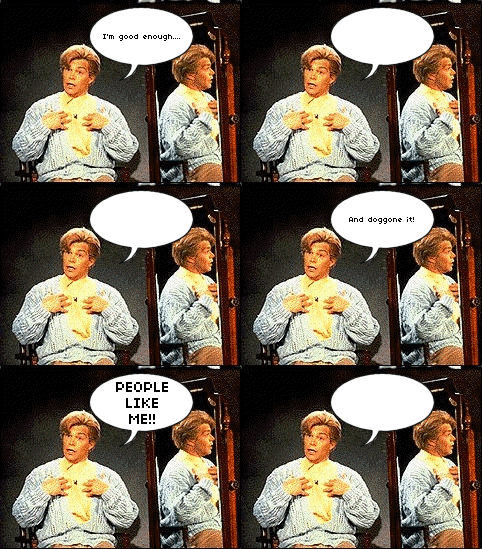 Today, Arbitron is still trying to gradually introduce the PPM...with some success in select test markets (such as Houston and Philadelphia) as shown for consulting Fly-Ins and web seminars. But lack of confidence still reigns...despite all parties' acknowledging the shift to digital ratings is essential.
Does Arbitron need some Stuart Smalley "Daily Affirmation" lessons?
In related PPM rollout news, another part of my conversation with Arbitron on digital ratings was about measuring In-Mall Advertising consumption, where moving, static and video ad boards emit digital code RF signals right along with code-embedded radio stations and other media and then measured by PPM devices worn by mall shoppers.
On Monday, Arbitron announced their first public test results for what they call their Mall Radio Network ratings system, showing great promise. Glad to see the results -- the Jointblog agrees this is a valuable new digital opportunity for media.
It's a new product the radio industry should to better understand the value of PPM -- whether from Arbitron or from some MediaAudit smartphone.
Electronic digital media is everywhere and capable to measuring real-time audience traffic and usage than the old diary recall system. Considering radio is a $20 billion advertising revenue industry, digital ratings system will provide more accountability and tranparency...with added confidence in radio's value, to boot. Meanwhile, the on-going trial LLC digital ratings PPM partnership between Arbitron (radio's gold standard for ratings) and The Nielsen Company (the gold standard for non-radio media ratings) called "Project Apollo" continues to saunter along with renewed energy.
What is Project Apollo?Project Apollo is a national marketing research service that collects multimedia and purchase information from a common sample of consumers in order to measure the return on investment for marketing efforts, promising to enable advertisers and media planners to know radio customers as brand buyers as well as consumers of media in a very strategic and actionable way, to help make media spending more effective and productive.
Move it all forward faster....the digital revolution is well underway.
posted by Unknown @ Wednesday, February 28, 2007,
,
DJ Play This Social Radio Networking Site: Mercora
Labels: Digital, DJs, Jointblog, Media Trend Watching, Mercora, Online, profile, Radio, social networking, streaming If you're into radio (as a music fan, talk fan or industry insider) and are tied of wading through junk social sites, you should check out a cool growing social networking site aimed at increasing DJ (and wannabe DJ) profiles. Music purists with a jones to get your DJ groove on will love it.
Mercora is a "social radio" network which enables users to become DJs and create their own user-programmed radio channel. A search function allows users to find specific songs, albums, artists, or genres of music.
It's MySpace or Last.fm without the BS junk.
"We're the largest social network you've never heard of," quipped Mercora's CEO Srivats Sampath to ClickZ.com's SearchEngineWatch. Sampath formerly was CEO of antivirus giant McAfee. Sampath said he chose to get into radio because it was "ripe for rewriting the rules of the game." The site served more than 1.3 million DJs last year, with over 3.5 million tracks in its database. There were over 400 million searches during 300 million visits, which typically lasted 32 minutes.
Mercora offers a Web application for casual listeners, playlist software for DJs, and a mobile product to enable smartphones to become wireless radios.
The main monetization method for Mercora is its "MadWords" program, a tongue-in-cheek reference to Google's search ads. It will serve music-based ads, triggered by a keyword search. Searches return links to all DJs on the network who are currently webcasting songs by that artist.
Mercora's mission? To catalog and organize the world's music and make it universally searchable and legally listenable. Quite simply, Mercora says "they've built the world's largest and legal music radio network composed almost entirely of music resident on people's computers."
Check it out and see what you think.
posted by Unknown @ Wednesday, February 28, 2007,
,
Web 2.0: Are we there yet?

Convergences, digital cross-platforms, "inflecting points", tipping points, synergies, peer2peer file sharing, user-generated mashups, social online networking, cellphone streaming...all promising the better digital life of Web 2.0.
Are we there yet? Is it us or using us?
posted by Unknown @ Monday, February 12, 2007,
,
It's about time: MTV/Viacom will make their video content available online -- on their own terms
Labels: Digital, Google, Jointblog, MTV, New Media, Viacom, Viral Video, YouTube After announcing earlier this month all Viacom/MTV Networks content must be pulled from YouTube immediately, there's news today that Viacom is prepping to make its videos available again to hundreds of thousands of other sites...on its own terms.
Not yours.
Meanwhile, YouTube doesn't care...as they take another step toward world domination as they go mobile.
Back to Viacom, according to Reuters:In the next few months, Web users will be able to grab videos from nearly all MTV-owned sites and post them on their own blogs or Web sites, lessening the need to go to YouTube, the top online video service that Google acquired last year.
MTV says they need to open their websites and content for consumers and for other companies. It's all part of a strategy to bring their sites up to what they call "Web 2.0 standards", allowing "people to take content and embed it to make their own things out of it."
Viacom, owner of MTV Networks and the Paramount movie studio, had been planning for this move months before it demanded earlier this month that YouTube remove more than 100,000 unauthorized Viacom video clips from its site, after failing to reach a distribution deal.
Yes, this is a move that needed to be done. But what took so long? Not to sound like a complainer or a told-you-soer...but why didn't MTV/Viacom do this two years ago? Why wasn't MTV the leader making this happen instead of being a long-asleep follower? Does MTV/Viacom really think web users, bloggers and media trend watchers won't see this as anything but manipulation?
With all the synergy of the Viacom/MTV Networks content umbrella (not to mention the CBS "Innertube" launch from a year ago), shouldn't this have happened long ago?
posted by Unknown @ Monday, February 12, 2007,
,
State of the Canadian music/record label industry
Labels: Canada, Digital, Music, Radio, Record industry trends As the Canadian music industry prepares for the CMW Conference in Toronto next month, the mood will be mixed. Radio realises it is holding steady (in terms of overall listening patterns, including total hours) despite all the digital pressures. Revenues are up and investment in new media extension projects continue to happen. Compared to the U.S., Canadian radio certainly seems more robust.
As the Jointblog pointed out last summer, there are substantial media trend differences between the Canadian and U.S. radio industries lately.
The Canadian record industry, though, is feeling the same hurt as their U.S. counterparts, with all majors making tough staff cuts in operations to counter changes in retail sales. According to Nielsen Soundscan Canada and Nielsen BDS airplay monitoring analysis of the record industry in 2006:> Overall music purchases were up nearly 10% from 2005.
Hold on because it's still a bumpy ride.
> Nearly 15 million digital tracks were purchased; an increase of 122% over 2005.
> The top 200 tracks accounted for nearly 20% of all track purchases.
> However, overall Album sales (including Albums and Track Equivalent Album sales) declined 3.2% compared to 2005.
> Total album sales declined 4.7% compared to 2005.
> Chain music stores accounted for 66% of all album sales, down from 71% in 2005.
> Classical and Country albums were the only two genres that gained in sales over 2005; up 21% and 15% respectively.
> Consistent with the previous two years, 25% of total album sales occurred during the Holiday Season (last 6 weeks of year).
posted by Unknown @ Saturday, February 10, 2007,
,
Google says Internet isn't TV
Labels: Cable, CES, Digital, Google, Internet, Jointblog, MacWorld, Media, New Media, TV, Yahoo TV is TV and the Internet is the Internet...but the differences between TV and Internet are getting more and more blurry.
You'd certainly see no difference if you went to last month's Consumer Electronics Show or MacWorld conferences, where the New York Times thinks the Internet is coming to TV.
High-speed broadband internet access is often bought from high-speed digital cable providers (who also sell VoIP)...so when we pay our monthly bill to just one provider, it gives the appearance TV and Internet might be the same thing.
View any late-night TV talk show and you'll see Leno, Letterman, Conan, Olbermann, Jimmy and Craig (and so many others) all making their own viral video picks found on YouTube.
If you read any interviews from AOL or Yahoo! execs over the past several years, you'll see a common theme describing the Internet as a new version of "interactive TV" and specific services they offer as "channels".
Internet access of audio/video programming through WiFi, WiMax, cellphones, iPhones and more.
So, aren't the Internet and TV becoming one-and-the-same? Certainly, they're sleeping in the same bed.
If 'a' equals 'b' and 'b' equals 'c', then 'a' equals 'c', right? Interestingly, Google, which acquired online video sharing site YouTube last year, says the Internet is not designed for TV, according to Reuters News.
It even issued a warning to companies that think they can start distributing mainstream TV shows and movies on a global scale at broadcast quality over the public Internet.
So why does Google say the Internet is not TV?"The Web infrastructure, and even Google's (infrastructure) doesn't scale. It's not going to offer the quality of service that consumers expect," Vincent Dureau, Google's head of TV technology, said at the Cable Europe Congress.
Hear that sigh?
Google instead offered to work together with cable operators to combine its technology for searching for video and TV footage and its tailored advertising with the cable networks' high-quality delivery of shows.
It's a collective sigh of relief from global TV broadcast executives finally hearing -- directly from Google -- that even Google sees limitations in their expanding empire. That TV will still keep its own platform. And that the Internet industry and the TV industry are capable of co-existing.
Does that mean they sleep in separate beds or in separate bedrooms?
posted by Unknown @ Thursday, February 08, 2007,
,
Instead of a SecondLife, why not Get a First Life
Labels: Alexa, Digital, GetaFirstLife, Jointblog, Media Trend Watching, New Media, Online, SecondLife, web traffic Last Fall, the online universe of SecondLife was the new media trend buzz. Now that more than 60% of Internet users at home log on through high-speed broadband, it seemed that a tipping point had been reached and passed. Brick-and-mortar business began buying real estate -- and even islands -- with their Linden dollars. People could meet and flirt (and even fornicate) with new "friends".
Suddenly, people could live a new virtual life.
Yawn. Many people found out having a second life can get too complicated. Or boring.
According to Alexa.com, SecondLife remains a popular web destination. But it's growth is slowing way down.
So what are people starting to do if they're not managing their SecondLife anymore. Perhaps revisiting their FirstLife again.
Oh yeah...the job, the family, the real things you're supposed to do.
Alexa says SecondLife is ranked #1,348 in total web traffic...still a strong amount of activity. However, its total reach has dropped significantly since its highest peak right after Christmas. Interestingly, the tongue-in-cheek website GetaFirstLife.com (with slogans like "Go Outside" and "Your world. Sorry about that.") is rapidly on the rise as Alexa's #2 "Mover and Shaker". It's rose 400% in traffic in the last week and now ranks #5,662 overall (up from 30,994).
No virtual life to live there...but you can get the t-shirt.
posted by Unknown @ Sunday, February 04, 2007,
,
Mobile WiFi Radio: What Radio could look like soon in a city near you
Labels: Clear Channel, Digital, eChannel, Internet, Jointblog, Mobile, New Media, Radio, Teens, WiFi, WiMax, Wireless Broadcast radio began ignoring teens right after Baby Boomers finally moved out of the demo 20 years ago. The only rare exception was the short-lived Alt Rock boom during the Grunge 90s. Yes, Top 40 radio still attracted teen listeners (what choice did they really have?). But, for the most part, radio strategically decided it needed grownup listeners in order to maximize revenues.
Teen radio listeners were accepted by default. Secondary. Most often, teen ratings have been viewed as a negative for a long time.
The rise of the Internet, file sharing, iPods, and Internet radio easily and quickly filled the void created by radio station ignoring teens. Now that the World Wide Web is 15 years old, an entire generation has grown up relying on the Internet, not radio.
What can radio do to begin connecting with current and future teens? And what do teens want?
Well, to start, radio can start appreciating, targeting and programming to teens. But, to do so, it needs to deliver ("broadcast") in a manner teens listen to their modern definition of "radio".
For teens, radio is a digital experience -- fluid, listened to in multiple formats, on multiple devices, time-shifted whenever they want to hear it. Radio was the original "wireless". Today's teens think of "wireless" in a completely different way. Wireless means something to communicate with -- cellphones, texting, emailing, WiFi, WiMax, Internet-based, fully digital and fully listenable on any and every digital device they own.
Last September, Toronto became one of the first major cities where a major radio broadcaster launched a new radio format available not over the old airwaves...but through the Internet to be heard on the new free city WiFi services.
Here's another new example of what radio could (and should) look like in cities everywhere, as reported in InsideBayArea.com:If a radio lover were featured on MTV's "Pimp My Ride", his or her car would look very much like the two Scion xBs that Clear Channel's new eChannelMusic was showcasing around San Jose earlier this week.
Attitude. Mobile. Edgy. Street.
These were rolling radio stations, although they never use the word "radio". They were WiFi Internet stations, programmed partly by listeners at www.echannelmusic.com with video screens, blaring waterproof speakers running 24/7, and a computer keyboard and screen and a large microphone in the back seat, from which street DJs could do commentary.
The $40,000 rolling studios are the first stations that the large Clear Channel radio company was programming without actual radio signals.
Remember when radio knew how to do that?
posted by Unknown @ Sunday, January 21, 2007,
,