

Jointblog update
For the past 20 months or so, the Jointblog has remained relatively inactive as I've been involved in additional media business activities. Interestingly, the Jointblog remains tops in Google among many strong keyword searches, including media media trend watching (where the Jointblog is still #1 in search results). So the content seems to remain relevant (at least by search standards).
The 600 posts and articles contained within the Jointblog are still accessible as archives and easily searchable here on the site.
Over the next few weeks, I'll be reactivating the Jointblog and revamping it with fresh perspectives earned from my recent media field work and other insights. Stay tuned...meanwhile, enjoy and happy holidays!
--Chris Kennedy
posted by Unknown @ Wednesday, December 17, 2008,
,


Beginning to look at 2007 Year-Ends
Labels: 2007, 2008, Jointblog, Media Trend Watching, trends, Year-end So it is December already.
2007 is wrapping up and Christmas songs are playing on the radio again while winter storms bring out the worst drivers on the road.
Lots to process through evaluating what happened in media for 2007...and what's in store for us in 2008:
If there is one phase that captures the biggest movement, it is this: Social networking. This is THE trend of media. Those that get it and those that don't. If you aren't on Facebook, guess which label between get it/don't get it applies to you.
As our friend Jerry Del Colliano explains it: Social networking is bigger than the Internet itself. More important than email. More pervasive than text messaging. This generation defines itself by making friendships and associations with each other."
Agreed.
Radio and social networking? Sadly, still misunderstood and still not even a boardroom agenda item, let alone the R&D initiative plans.
How'd we do with other media trends?
Media revenues? Internet ad revenues still surging, as predicted...almost on par with radio in the U.S. Meanwhile, total radio revenues slipped in the U.S. (still growing slightly in Canada), while the big American consolidators continued their property sell-offs (radio still viewed as a positive acquisition north of the border by the media analysts).
The XM-Sirius merger? Almost a done deal.
The iPhone and Touch? Big hits, with radio still unable to capture any real estate on the device. But are Zunes picking up some steam?
Apple ads? Still cool. Chocolate Rain? Still weird.
Clear Channel firings and layoffs to clean up the books to boost "performance"? Yep, right on schedule, as usual.
Resolution on royalty rates for web streaming of music and radio in the U.S.? Nope, of course not. And now Yahoo! and AOL are considering plugging their radio plugs. too.
PPMs? More announced rollout delays...but still coming...
Colbert? I TOLD you so!
And Katie Couric's legs? Still mysteriously searchable online...
CBS Radio? More relevant again. Opie & Anthony? Less so. Imus? We'll see (nice tan, though).
Howard Stern? More and more...who?
AOL? Parsons moves on, with very little innovation to show for his leadership. He stopped the bleeding...but the patient may not ever recover.
Celebrity meltdowns? Wow, we've actually gone a few months without a scandal! Look out...we're due. And there's still one month left till 2008...
Wii, XBox or PSP? All three are winning.
Political YouTube debates? A curious new toy...
What are YOU seeing? We value your feedback.
posted by Unknown @ Saturday, December 01, 2007,
,
Transitions in Media Trend Watching
Labels: Being digital, Business, Chris Kennedy, Digital, Digital life, Joint Communications, Jointblog, Media Trend Watching, Parikhal, Radio, Transitions, trends Recently, the Jointblog passed 500,000 total page views to our site – and we are less than 3 years old. It’s hard to believe that our site is older than YouTube.
This blog was started and developed by Chris Kennedy as a way to focus on Media Trend Watching – a core competency at Joint Communications.
It surfs the wave between pop culture and business insight, a world of instant fame or shame where old media power is challenged by new media behaviors. There’s never a dull moment.
After working with me for over 15 years, Chris decided to return to his first love -- radio -- joining Corus Entertainment, a multi-media leader in old and new media, as Program Director of Montreal's Q92.
Chris has kindly agreed to continue the Jointblog so that we can keep an eye on media trends – big or small - from NBC’s rearguard action against Apple (refusing them content) to YouTube’s unpredictable effect on the upcoming Presidential elections.
And, the most significant trend we’re watching right now is the digital divide – the gap between those who are online (especially with high speed connections) and those who aren’t. America's lagging behind many developed countries in broadband per capita, including South Korea and Iceland.
The beauty of today's digital world means Chris and I will maintain our high-speed association with one another -- efficiently transitioning us from the Joint connection to a new digital connection.
posted by John Parikhal @ Wednesday, September 05, 2007,
,
Web Analytics: The Actives and Less Actives
Labels: Being digital, Digital life, Internet, Jointblog, PEW, trends
Sure, for many...but not all. First of all, the technology needs to work. When it works, being digital can mean greater productivity...or it can be overwhelming just trying to keep up with the upgrades. Or frustrating to fix when there's a glitch or interface problem, even among those who know what they are doing. And shopping!
Just consider all the different number of gadgets and digital options. To many, it remains very intimidating.
If you consider yourself a "wired" person, it is easy to forget the rest of the population. Not everyone is as happy with this digital life as you might be.
According to the latest update in the PEW Internet & American Life Project, 59% of us are less than thrilled with new digital connections and options, as illustrated in the graphic table above ("The Digital Less-Actives").
Based on their on-going national panel study:
- 10% of us are "connected but hassled"
- 8% are "inexperienced experimenters"
- 15% are "light but satisfed" digital users
- 11% are digital "indifferents"
Meanwhile, 15% are completely "off the network". They have neither a cell phone nor internet connectivity.
Add all those user segment groups together, that's 59% of the total population describing themselves as either non- or light-users. 59% that currently are not active digital users.
Does that surprise you in 2007? Being a digital person (after all, you are reading this Jointblog post), wouldn't you expect to see more people being digital?
What it means is we still haven't reached the peak for a full digital life in society. There continues to be opportunity to reach new consumers.
The key?
Make it simple.
Make it easy.
Take away fear and frustration.
How well are you connecting with your potential digital audience? Are you making it too hard for them to use your site? Too difficult to be interactive with your digital audience? Are you giving your audience too much choice, too many options?
What can you do to make their digital life more simple?
posted by Unknown @ Sunday, August 05, 2007,
,
New Adventures in Media Trend Watching
Labels: Chris Kennedy, Future, Future of Radio, John Parikhal, Joint Communications, Jointblog, Media, Media Trend Watching, Radio, Strategy "Move forward, young man...while you are still young."
Not sure who said that but I do know a consulting associate from Joint Communications -- Bob Elliot -- who was once asked how he defined growth.
He said, "Well, if you are not growing, you're dead."
Perhaps a little blunt but there is truth in those words, both personally and professionally.
We all seek growth in various forms through our relationships, our businesses and careers, our learning, our finances...the list goes on and on.
As Peter Drucker has said (loosely paraphrased), an important key in growing successful long-term management is for executives, directors and managers to periodically return to day-to-day operations and get away from the "boardroom". It allows for managers to understand what has changed and what needs to happen for future growth.
In the rush-rush of decision making and strategic guidance throughout fiscal years following the pressures of meeting budget and performance expectations, managers can easily shift away from the realities out on the floor before they realize it.
Consultants are no different.
We fly in, work our magic, stir up the team toward growth and fly back home, following up to help make sure decisions stick into on-going action.
This ability to lend an outside perspective to operations allows consultants to see competitive challenges partner clients may not be able to see for themselves. It is a major strength for the consulting role, one that the rapidly-evolving media industry still needs for both the mature sectors of "traditional" media like radio, TV, the music industry, magazines and newspapers...as well as for "new" media, such as cable, modern telephony, wireless, satellite, and all-things related to the Internet.
But, over time, this outside role has its limitation, for the consultant remains on the "outside" of everyday operations. With so many constant and fast changes happening in media, getting back periodically into the daily functions of media business keeps the consultant up-to-date with industry realities.
Which is why I have made a new step forward.
For the last 15 years, I have worked and partnered with John Parikhal at Joint Communications consulting our international roster of media clients. An amazing thrill for me, allowing for constant learning, unique situational decision making, and cross-pollination experience throughout the media industry's up-phases, downturns, IPOs, mergers & acquistions and new tech advancements.
For the past couple months, I've been getting operational again, serving as Program Director for Montreal's Q92fm -- a heritage mainstream AC radio station and one of Corus Radio's many great stations across Canada. It's a new adventure for me, allowing me to pursue growth on a whole new level for a long-time client.
Of personal and professional importance, it also allows me to "get operational again" doing what I love to do: programming radio, coaching talent, building cooperation and communication between station departments, getting deeply involved with the community, building new station events and promotions, managing brand building efforts, and, ultimately, entertaining our audience in the best way possible while also serving as an effective advertising media choice among our station clients.
It's media trend watching on the street level. And I'm having a blast.
What better way to understand the "future of radio" than following Peter Drucker's advice and getting operational again?
I'm proud of what has been accomplished with Joint Communications and our clients. The Jointblog is the #1 destination online for people interested in media trend watching (according to all the search engine results and traffic meters)...these changes will offer a new new level of perspective for future Jointblog posts.
We encourage you to keep sharing your thoughts.
And keep Jointblogging!
We will.
I'm off now for our street festival concert event...literally getting back to street level...
posted by Unknown @ Sunday, July 15, 2007,
,
Media Buyers: Why 40-59 Year Olds Still Should Matter
Labels: 40-59, Advertising, Baby Boomers, Echo Boomers, Empty nesters, Influencers, Jointblog, Marketing, Media, Media Buyers, Media Trend Watching Quick: which demographic has collective disposable income estimated at about $2 trillion a year...and yet are considered secondary targets by marketers and media buyers?
If you are a Baby Boomer, you're used to being the center of marketing attention. You expect it, since it's been that way most of your life. Today, though, you might be feeling a bit jilted. You...and more than 86 million "mature" consumers. Since the turn of the millennium, media buyers have shifted their advertising dollars more and more to younger consumers...especially to today's teens and other Echo Boomers.
Of course, the marketing game has long been a youth game. And 18-49 clearly is important. The "big generation" Boomers made sure of it.
Still, Baby Boomers represent more than 25% of the today's population in both the U.S. and Canada (down from 40% in 1967). Traditional media buying beliefs states the strongest marketing ROI comes from younger consumers still-moldable for brand building opportunities. It is believed older, smarter, wiser Boomer consumers are less susceptible to marketing messages.
Nonsense. Do you really think Boomers are ready to retire and become irrelevant?
Baby Boomers have money, they aren't afraid to spend it and their minds aren't locked on life-long brands. They want content and marketing geared for them. And they can be influenced, too.
Here's why:
More than three-quarters of advertising buys for all media today targets consumers younger than 49. The only major media buys that are "boomer friendly" are newspapers and magazines (to a lesser extent).
TV, radio, the Internet, billboards, etc...they all seem to consider Boomers less "valuable" than 18-49s, teens or younger...even though Boomers remain heavy users of all media.
This means there is over-saturation of "young" media messages (especially on TV, the Internet and even radio). Since Boomers are getting targeted less, they also have fewer marketing messages "in their zone".
What do they see or hear?
Ads on retirement, pension plans, vacations, Big Pharma and Depends.
Come on now!
These are Boomers. They only started turning 60 this year. And they strongly want to hold onto whatever youth they still have. They mostly still need to earn a living and probably will keep working at least another 7-10 years. They are healthier and wealthier than any generation previously in this age demo.
And, surprise, the "aging" baby boom generation still LOVE media -- including new media and the latest gadgets, embracing the Internet, high-speed and everything related to it.
A new national study by BoomerEyes found:• Nearly 40% of those with kids said they’re now “Empty Nesters”;
Echos reverberate. Could Baby Boomers attract back marketing attention as Reverse Echo Boomers? This new advertising "generational gap" represents a massive opportunity. What are you doing to tap into it?
• In addition to having the time to do what they want and when, the Empty Nesters also report financial freedom. On average, they said they have $315 more per month to spend;
• Some 71% of 50-64 year olds and 84% of 30-49 year olds report high Internet usage. Even among those 65 and over, regular Net usage is reported by 32%;
• Boomers who took the online survey say they most often shop online for travel (58%), books (57%), clothes (57%) and electronics (50%).
posted by Unknown @ Saturday, May 12, 2007,
,
Radio Finally Realizes It Can Do Social Networking, Too
Labels: Clear Channel, community, Internet, Jointblog, MySpace, Online Marketing, Radio, social networking, website The success of MySpace has spun off an emerging trend of new social networking startup site based on specific themes and custom labels. And now radio is joining the online marketing action.
Billboard.biz reports today that America's largest radio company Clear Channel is starting up its own radio-branded social networking websites, with plans to get them up and running throughout this summer.
The concept? "Mini-MySpace" sites associated with a major market's radio brand logo targeting that stations' local community audience, allowing users to create and customize their profiles, upload their user-generated content and viral video, form friendship links, post comments and generally connect with other like-minded people.
At the same time, the radio stations with have a new opportunity to promote its activities and contests as well as community events, gossip, new music releases and even on-air podcasts.
Finally.
It's only a decade late.
But at least it finally getting done.
How about the other radio groups? Some Clear Channel example sites launched today: The Wild Space for Rhythmic CHR Wild FM in San Francisco; The Mob for Top 40 Kiss FM in Chicago; The Z-Zone for New York's Top 40 Z100; Kiss Nation for Top 40 Kiss FM in Dallas; and many more to come from stations across the country based on new music formats.
Will they just be LateSpace?
What took radio so long to wake up to the social networking phenomenon of the last decade? The Internet started as a community connector to share information (digitally) back when it was bulletin board Dos-based postings accessed via slow-baud dial-ups -- long before AOL IMs, or even chat rooms in CompuServe or Prodigy. Radio could have -- and should have -- established online social networkings long before MySpace, Facebook, Friendster, Bebo, Zanga, Eons, UrbanBaby or any of the others popular places online today. Radio already had (and still has) established built-in interactive communities, including local fans as well as listeners who've relocated to other cities who remain fans.
Clear Channel's plans will "monetize the sites with targeted online spots from local advertisers" while helping people connect with others locally. Meanwhile, users will be able to click on the user profiles in the chat area to enter and explore the social network.
According to the news release:Each social network will have a user experience similar to that offered by MySpace, Facebook, Bebo and others. Users can create and customize profiles; upload photos, music and video; blog; and add friends. Users will also be able to enhance their profile pages with videos from Clear Channel's catalog of over 6,000 music videos licensed from major and independent labels.
Yes, social websites are one of Top 10 things teens love to do. The timing is good for radio to step in and offer something fresh, especially since MySpace is turning more and more into a junkyard mess.
But it's not just teens that want to socially network online.
It's grownups, too -- GenXers and Boomers alike. Adult Contemporary, Classic Rock, Oldies and other adult music formats should also be included. There's lots of competition among the most active social networking websites. Breaking through will be tough. Corporate Radio is slow joining the bandwagon when it comes to online social networking...perhaps its expertise in formating and its built-in on-air audience can help radio stations get the word out while creating a unique online community destination.
Just help users cut through the clutter!
It does lead to an interesting modern-day question: How many online profiles can a person possibly have and keep up-to-date while still keeping up real-life responsibilities? Three? Five? A dozen? More? How many multiple personalities are we all living every day?
And another question: what will radio do about mobile social networking (like Twitter, etc.)?
posted by Unknown @ Monday, April 30, 2007,
,
Media Trend Watching: Radio Right Now
Labels: cellphone, FMQB, Google, HD Radio, Internet, John Parikhal, Joint Communications, Jointblog, Karmazin, Media, Media Trend Watching, MySpace, PPM, Radio, Sirius, XM Joint Communications marks 30 years this month advising the radio industry through format programming, consulting, market research, marketing development and media strategy services.
The month of April also means it's time for John Parikhal's annual spring check-up as this week's featured FMQB cover story to discuss radio and the evolving mediaspace challenges radio faces in the immediate future.
Among the discussed topics:
> The proposed XM/Sirius merger -- including the financial and competitive implications as well as Mel Karmazin's catalyst role (puzzling; Stern probably helped save Sirius; Mel sees opportunities)
> The trend led by Clear Channel and other big groups toward privatization (more squeeze and bleed? And Clear Channel gets rewarded?)
> HD Radio (just another local spectrum)
> PPM ratings measurements (consistency of measurement will help)
> The cellphone (risky for electronic ratings measurement)
> Blink spots and other "Less is More" initiatives (applaud the experimentation; spare listener energy; don't invade the consumer)
> Radio's needed presence on the Internet and its mishandling of opportunities that went to MySpace instead (getting better...but still behind due to insufficient support staffing and streaming fee penalties)
> Google's new deal selling radio ads ("It's nonsense")
> The lucrative potential of selling and targeting the 30-59 year old demographic (so much money radio could grab)
> An updated look at radio's emerging trends (demographics!)
FMQB's chief editor Fred Deane gets it all started by saying:As the radio industry evolves at a rapid pace, critical decisions about the medium’s future become increasingly more urgent. Technology issues have enveloped the industry to such a challenging extent, that the call for radio leaders to be actionable has never resonated so loudly. John Parikhal has never met a challenge he didn’t like, he relishes the very concept. While Parikhal’s client list continues to remain firmly entrenched in radio, the macro version finds him involved with a variety of media and marketing companies. His latest foray with strategic Internet initiatives with some large clients has him thinking about the future 24/7. It’s spring and time for our annual check-up with one of our industry’s deep thinkers.
Thanks, Fred. All that and more...just click here for some great reading. Then come back and add your thoughts here on the Jointblog.
Additional reading: Thinking Through The Decision Making Process
posted by Unknown @ Friday, April 27, 2007,
,
Howard Stern and Predicting American Idol 2007
Labels: American Idol, Gossip, Howard Stern, InTrade, Jointblog, Media Trend Watching, News, Pop Culture, Predictions, Radio, Sanjaya, Sirius, VoteForTheWorst Howard Stern made some news this week, saying he wants to "kill" American Idol by "corrupting the entire thing", hoping "to turn the talent competition into a farce and destroy its popularity."
He's backing VoteForTheWorst's campaign to keep Sanjaya Malakar, whom the New York Times called "the off-key, lyric-fumbling, elaborately coiffed teenager who is perhaps the most talked-about “Idol” contestant ever.
This is nothing new...Stern has commented about VoteForTheWorst's weekly picks for the last three years. What's different this year? Instead of just referencing it within Robin Quiver's news segment, Stern's gave the site's owner an on-air inteview. This ramped up VoteForTheWorst's web traffic, got lots of news services and blogosphere attention...and attracted Stern criticism.
In other words, fresh publicity, quickly attaching Stern to the #1 TV show in America.
Genius.
He has a much smaller audience now on Sirius compared to what he used to have on traditional radio...but he still knows how to place himself at the center of controversy and water cooler buzz. And his fans love him for it. Does he want to "kill" off American Idol by supporting a part-time website run by a Chicagoland community college teacher? Of course not...it provides easy fodder for him to mess with year after year. And it gives him a chance to rub mainstream media's nose in his crap.
If it's not American Idol, Stern would be attacking some other #1 show.
That's what he has done his entire career. Brilliantly, even if you don't like his methods. So Stern wants Sanjaya to win. Simon Cowell says he'll quit if Sanjaya wins. According to an online prediction market website, Simon Cowell, American Idol fans and Freemantle/Fox executives won't have to worry about that outcome.
InTrade.com has a freakish habit of (almost) always being right in their predictions. In the last U.S. election, the site successfully predicted the outcome in every state. In the Scooter Libby trial, Intrade successfully predicted the odds of a guilty verdict to be 70% (Libby ended up guilty on four out of five charges -- or 80% of the charges). InTrade's success reportedly relies on the number of people who use the given "market", however that market is defined. People "buy" and "sell" outcome "shares" online as events happen, tapping into the wisdom of the public.
So who does InTrade predict will win American Idol in 2007? (once on the site, click "entertainment", then "American Idol") As of today (April 1), 83% say a female will be the new Idol, not a guy. 50% say Melinda Doolittle will win the contest, with Jordin, Blake and Lakisha far-behind tied for second-place (14% of "win" votes each). Only 3% think Sanjaya will win.
Yet, they also don't think Sanjaya will get voted off this week; they think he'll be sticking around a little while longer while Haley will be the one to get booted.
Will InTrade get it right? Maybe, maybe not. Sanjaya backlash could happen...or it might carry him all the way into May sweeps. The odds will change as the show's dynamic changes...and Sanjaya may stick around for more farce value (hey, it is good TV).
Is Howard Stern behind Sanjaya's staying power? Whatever. It's TV. It's American Idol. Howard Stern will still create news ranting against pop culture. Even though he's on satellite radio.
related NYTimes.com article here (log-on may be required) or AOL.com article here
posted by Unknown @ Sunday, April 01, 2007,
,
Brand Building: The Seven Essential Connections
Labels: brand building, Branding, Customers, Jointblog, Marketing, Seven Essential Connections, X Factor New media has shifted marketing perception suggesting the rules for brand building have dramatically changed.
Actually, the rules haven't changed -- and neither has the end goal. Rather, it's the methods and choices used to build those brands that have changed the way brands are marketed, with some new powerful tools gaining popularity and other previously-strong tools losing power (or already lost it).
Here's what remains as true and essential today as always: for significant and meaningful brand building connections and branding engagement, brands have to share common ground with the desired customer.
What does this mean?
The relationship between brand and customer must represent something real to the customer; otherwise, the brand doesn't matter in the customer's world. Miss this connection and you certainly won't motivate brand advocates.
Successfully-built brands have to be genuine and based on the real values and vision of the brand. Larger brand audiences and market share dominance happen when the brand links distribution of the brand intention with the brands perception. It's the bedrock of trust and common ground, allowing the relationship between brand and consumer to grow and prosper.
What are the Seven Essental Connections for Successful Customer Brand Building? The brand MUST share with the customer:
1) Life values (self-identity)
2) Core "roots" (history, heritage, religion, etc.)
3) Cause (forward-moving purpose)
4) Mutual interests and/or benefits (time spent together)
5) Lifestyle (community)
6) Hobbies (interactivity)
7) Preferences (like and shared dislikes)
Brands that connect with customers on all seven levels consistently are engaged. And yes, bottom line results are important just as it is for owners with brands not fully engaged . Look at some of the biggest successes: Apple, for example. BMW and Toyota (including the new Scions) for cars and Ford for trucks. Even TV shows like American Idol, Lost, Heroes, 24, The Daily Show and The Colbert Report. Each connect on all seven levels...and deliver financial results and customer buzz.
But not all brands connect on all seven levels.
Why not?
Most brands don't consciously concentrate on servicing, staffing or budgeting the brand on those 7 levels. Which is too bad; if they did, the brand would earn the cherished "X Factor"...that special extra oomph in brand value making it superior than any competitor.
How well is your brand connecting?
posted by Unknown @ Monday, March 26, 2007,
,
Content Matters...But Distribution Rules In Media
Labels: Big Media, Content, Distribution, Google, Jointblog, Media Trend Watching, New Media, Time, Traditional Media, Viacom, What's Next, YouTube Distributors are the ultimate media gatekeeper.
When Time magazine named "You" as its 2006 Person of the Year, it attracted mixed critical response. Some thought it was brilliant, others thought it was a cop out. Whatever. That editorial decision did announce something fresh: one of traditional media's pillars of print media acknowledged the cultural significance of today's digital new media reality.
2007 has delivered major changes within Time, including mass job cuts, retirements and restructuring as well as a new delivery date (Fridays instead of Mondays). It's also brought about many design updates and content adjustments, intended to tighten up the partnership between the weekly magazine and the daily updates of Time.com.
Among the subjects Time features more is a regular look at "what's next" in consumer tech and media, which grabs this media trend watcher's attention. This week's "Curious Capitalist" writes that "Google Gooses Big Media" (wha?...what exactly does that mean?...has Big Media's butt been pinched?). For a traditional (mainstream, or MSM) print media publication to say "The search giant rewrote the rules of distribution and selling ads...The big movie, TV and print outfits may never catch up" is startling.
Why?
Well, first of all, they're admitting Google is now the leader steering media's growth -- not the TV, Print or Movie industries (and, by its absence, certainly not radio).
Secondly, while it's good news one of the biggest mainstream media publications in the world acknowledges new media's (and specifically Google's) importance in the total media mix...this "news" arrives several years late.
Lastly, Time Inc's viewpoint seems completely opposite of Viacom's effort to turn YouTube into SueTube.
The article does drive home excellent points, especially how it puncture's the tired adage that "content is king"."Content is king." It's a phrase uttered repeatedly by media executives making the case that the movies, music, TV shows, books and journalism their companies produce are the core of their business.
Yes, content matters...but that's a bit of a smoke screen. Distribution of content is what's always mattered. The owners of printing presses since the 17th century. The owners of radio towers and transmitters throughout the 20th century. The same has been true for the record/music industry, the TV industry, the cable industry...and now the top domains online.
It happens to be a dubious claim. Sure, movies, music and TV shows have value...But they alone have never generated the huge, reliable profits that keep investors happy and pay for midtown-Manhattan skyscrapers. No, the big money in media has always been in distribution.
Sometimes the media companies do this distributing themselves -- big media have long been defined by their ability to make sure their products are displayed prominently there. "The historical media play," says consultant John Hagel, "is having privileged access to limited shelf space." Extending content value through syndication rights and efficient distribution "pipelines" (or "networks" or high-speed wireless linkages, etc.) is really where it's at. Always has been...and it continues to be that way.
The trend: Mainstream media is still slowly figuring out new, better ways to marry its traditional media distribution system with its online distribution opportunities. As archaic copyright rules over content control evolve (such as DRM), will regulations tighten or relax? The battle over the next 5 years will be fierce and worth watching.
What do you think?
posted by Unknown @ Sunday, March 18, 2007,
,
Media Trend Suggestion Box
Labels: Joint Communications, Jointblog, Media Trend Watching, Suggestion Box Do you have a suggestion for the Jointblog or a topic tip to help us media trend watch? Here's a great place to participate. You can always make comments to posts or contact us with new suggestions by clicking here to comment or here to email! And you'll get the credit for the tip with a link to your own site (unless you'd like to remain anonymous).
Thanks for media trend watching!
posted by Unknown @ Thursday, March 15, 2007,
,
Big Audience: Internet reaches 747 million people worldwide, Up 10 Percent
Labels: comScore, growth, Internet, Jointblog, Media Trend Watching, New Media, population, users How many people use the Internet? According to new data from comScore Network's World Metrix service, the Internet reaches 747 million people worldwide. How big is that? Slightly more than Europe's total population of 710 million people. The total world population right now? Nearly 6.7 billion. That means the Internet reaches 11% of the world.
That's a big audience...but there's still lots of room to grow.
And grow it has. Overall, the amount of global web users increased 10 percent over the past year, with about 74 million new users.
According to the report:The greatest growth over the past year comes from India (33 percent); the Russian Federation (21 percent); and China (20 percent).
The U.S. still dominates Internet usage, with more than 153 million total users online -- a 2% gain since last year. US users average 32 hours a month online...but broadband users take advantage of their high speed, averaging 37 hours per month.
Online engagement topped an average 27 hours spent each month in the top 10 user countries. Hours spent online was strongest in Canada (39.6 hours); Israel (37.4 hours); and South Korea (34 hours).
Canada tops broadband hours used at 41 hours a month.
The top sites total worldwide? Microsoft, Google and Yahoo lead the Top 3.
posted by Unknown @ Tuesday, March 06, 2007,
,
Wayback Machine: The Internet circa 1993, courtesy of the CBC
There's an old CBC Newsworld report from 1993 re-circulating via YouTube and the branding / media tech blogs. If you missed its first viral viewing last summer, its catching on once again, touting something new (at the time) called "Internet", which cost about $200 a year to use. All you needed back then (in addition to the $200)? A personal computer (note the pre-Windows PC OS used in the background) and a phone hookup to be up and running "data exchanges" around the world with the other 15 million users.
Pretty amazing trip back in time...
When can we get "Internet" costs back down to only $200 a year?
posted by Unknown @ Wednesday, February 28, 2007,
,
DJ Play This Social Radio Networking Site: Mercora
Labels: Digital, DJs, Jointblog, Media Trend Watching, Mercora, Online, profile, Radio, social networking, streaming If you're into radio (as a music fan, talk fan or industry insider) and are tied of wading through junk social sites, you should check out a cool growing social networking site aimed at increasing DJ (and wannabe DJ) profiles. Music purists with a jones to get your DJ groove on will love it.
Mercora is a "social radio" network which enables users to become DJs and create their own user-programmed radio channel. A search function allows users to find specific songs, albums, artists, or genres of music.
It's MySpace or Last.fm without the BS junk.
"We're the largest social network you've never heard of," quipped Mercora's CEO Srivats Sampath to ClickZ.com's SearchEngineWatch. Sampath formerly was CEO of antivirus giant McAfee. Sampath said he chose to get into radio because it was "ripe for rewriting the rules of the game." The site served more than 1.3 million DJs last year, with over 3.5 million tracks in its database. There were over 400 million searches during 300 million visits, which typically lasted 32 minutes.
Mercora offers a Web application for casual listeners, playlist software for DJs, and a mobile product to enable smartphones to become wireless radios.
The main monetization method for Mercora is its "MadWords" program, a tongue-in-cheek reference to Google's search ads. It will serve music-based ads, triggered by a keyword search. Searches return links to all DJs on the network who are currently webcasting songs by that artist.
Mercora's mission? To catalog and organize the world's music and make it universally searchable and legally listenable. Quite simply, Mercora says "they've built the world's largest and legal music radio network composed almost entirely of music resident on people's computers."
Check it out and see what you think.
posted by Unknown @ Wednesday, February 28, 2007,
,
XM/Sirius Merger: WWHT? (What would Howard think?)
Labels: CBS Radio, competition, FCC, Jointblog, Karmazin, merger, NYPost, rumours, Satellite, Sirius, Stern, XM "Wha-wha-WHAT?" (if you've been a Stern fan over the years, you know the SFX)...
This gave me a laugh reading Jossip's Media Blitz this morning. Too bad I was drinking my coffee at the time (thank god for Bounty):Sirius and XM merger described as imminent possibility; Howard Stern described as "too rich to care."
Of course, whether this announcement happens or not, the next 15 months of FCC regulatory hell would serve as either a sideshow or a distraction...and Stern will still be "too rich to care".
(canned applause in response)
Obviously, it is a BIG deal, if it can get through. A predicted operating savings of $7 Billion (if an accurate estimate) means satellite radio has a much better chance of thriving and surviving. But at what cost will come those savings? There's always a cost... Update at 1:30PM EST: ABC NEWS has "confirmed" through their sources the merger deal is happening today, although it has not been announced or commented directly by either XM or Sirius officials...yet.
So...if the story is accurate and eventually approved, how would the merger play out? Here's one way to see it...(click through)
Here's another point of view from Wall Street. And more. And yet more comments on the possible end of XM's and Sirius' head-to-head competition.
Winners and losers? Your thoughts?
Another update (3:45pm EST): It's now official.
For a MoneyCentral financial analysis of Sirius share/investor history and its future prospects, click here.
So what does Howard Stern and Mel Karmazin think about the merger? Click here and here.
posted by Unknown @ Monday, February 19, 2007,
,
2007 Trend To Watch: Widgets
Labels: dashboard, gadgets, Google, Jointblog, Konfabulator, Media Trend Watching, New Media, widgets, Wireless, Yahoo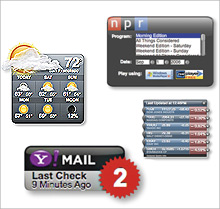 Want to build your brand cross-platiform but having trouble getting it to happen online? Widgets just may be your answer.
And it's cost-effective, too.
The Jointblog has been a longtime fan of widgets since first discovering Konfabulator in 2004 (later purchased by Yahoo! a year ago). With the release of Window's new Vista platform, PC users will get a whole new array of widget options (also known as "gadgets") for the desktop which will pull more Internet activity off of web browsers and onto these customized mini-applications.
Widgets were one of several great additions for Mac's OS X system, epecially for its Dashboard advancements for 10.3 and 10.4 in the last year (expect even more once Leopard 10.5 and the new iPhone are released this summer).
And Google already has invested deeply into widgets, too. In addition, as WiFi and WiMax helps make the web more accessible with mobile devices and cellphones, widgets will be the key killer app to make the web tolerable to use when mobile.
It's the perfect bridge technology bringing "old" media into the new media world.
Business 2.0 said "suddenly everything's coming up widgets." In November, Newsweek proclaimed 2007 to be the Year of the Widget and we couldn't agree more. Last month, West Coast wireless carrier AllTel previewed its new widget-handy cellphone tools and received rave reviews for it at January's CES.
Most powerfully, these widgets create focused user experiences giving exactly desired content immediately, on-demand, 24/7, when the user wants it.
For content owners, it also provides an advertising opportunity that can be built right into the widget app.
It's the media trend the Jointblog continues anticipating to grow in significance.
The big question: will traditional media sources such a radio, TV, newspapers and magazines be too slow to notice or will they see the low-cost, ease-of-use opportunity in time?
If radio could figure out its DRM and AFTRA issues, it could create the perfect bridge to build fast online tuning. For example, RadioSherpa's radio badges.
What's going on with your radio station this week? On your morning show? Latest contests and promotions? How about for your market's entire cluster of radio stations? It can all be done on one widget you build. Auomatically, through RSS and other feeders.
Nice and easy. For you. And, more importantly, for your listeners' digital online needs.
Good follow-up article: What's Up With Widgets?
For a quick review of why widgets matter now, here's a 2-minute YouTube/Engadget clip explaining the immediate value of widgets and why you should consider offering customized widgets for your own users to use, install and even embed into their blogs and websites (which, if done, can serve as a free form of marketing for you):
posted by Unknown @ Sunday, February 18, 2007,
,
That Amazon.com search brain sure is smart
With the media going gonzo 24/7 over the Anna Nicole Smith deathnews, I didn't think there would be any need for the Jointblog to make comment. I mean, what else can be said that Mark Steines hasn't already covered on ET? Labels: Amazon, Anna Nicole Smith, Jointblog, search, thin-slicing, Train wreck
I did see this item worth noting, though, showing how smart and intuitive at thin-slicing Amazon.com's recommendation engine can be:
If only the Amazon.com Brain could come up with solutions preventing these train wrecks from happening in the first place...
posted by Unknown @ Friday, February 16, 2007,
,
Favorite TV show viewing: Using Internet as TiVo
Labels: ABC, brand building, Information Superhighway, Internet, Jointblog, Media Trend Watching, NBC Rewind, streaming, TiVo, TV, VCR, Video player, Viewing The Information Superhighway keep winding and twisting. Lately, I wonder if it's becoming the new TiVo.
My TV viewing schedule has been messed up -- again. Like most people, I no longer am held captive by just a few channels. I bounce all over the place: different favorite show on a different channel on different hours. I rarely keep the TV on the same channel for back-to-back shows (same thing for my teenage daughter).
Some things are an absolute must. 24 Monday night at 9pm on Fox -- a must watch. My friends know not to call until after it's done. Heroes is another must watch -- but it's broadcast on-air at the same time as 24 on NBC.
So what do I do?
What about Wednesday nights at 10pm now, when Medium and Lost air at the same time? Or Thursday night's 9pm block, when Grey's Anatomy squares off against NBC comedies? Or when I simply don't have the time to watch at all? I never use my VCR -- gave up using that wasted old tech device a long time ago. I don't watch or care enough about TV to have a TiVo either, even for my high-def big screen.
My solution?
Same as it's been for millions of people. The Network's online streaming sites, especially for ABC as well as NBC's Rewind. The Internet is quickly becoming the new personal video player. And it's helping the TV networks build their brands online.


ABC got off the block first streaming full episodes almost a year ago a little roughly...but it has gotten much better since then. Fewer streaming dropoffs and more shows to watch. And far fewer commercials than what you'd see during a TV broadcast.
CBS launched their Innertube last summer while NBC waited to launch their full episode site in October -- last among the Big Three networks.
In my humble opinion, despite being last in, NBC's Rewind service is far better than either ABC's or CBS's service. Already, NBC's Rewind has delivered 42 million full show viewings.
My personal rankings:
#1 -- NBC
#2 -- ABC
#3 -- CBS
A new Mediaweek article reports that many are using the Network streaming sites just like I'm doing: as their personal TiVo. Just look at these just-released results for NBC:> 78% of users who streamed full-length episodes watched shows from the series they usually watch but missed on broadcast television.
This is a huge result. As a viewer, I say thank you broadband! The Internet is quickly becoming my personal video player. This model makes sense and is one to watch as a media trend.
>81% of those surveyed said they recalled specific pre-roll ads -- using single sponsors for entire shows playing only one commercial per break certainly helps make for powerful recall.
>26% said they viewed shows they had already watched on TV for a second time.
>34% said they used the site to preview shows they had never seen before.
I know I am.
posted by Unknown @ Thursday, February 15, 2007,
,
Police Reunite While Motley Fool Chooses: Sirius, Apple and XM...Which would you "Date, Marry or Kill"?
Labels: '80s, AOL, CBS Radio, Ethel, Jointblog, Motley Fool, Police, reunion, Satellite, Sirius, traditional, XM Yesterday, I heard the type of event I thought radio had long forgotten: The Police's Whisky A Go Go press conference and live rehersal preview of their reunion tour this summer the morning after their opening performance on Sunday night's Grammys.
Where did I hear this live, commercial-free broadcast?
Sadly, not on traditional radio. I heard it on XM's Ethel. On my computer. Through XM's AOL service. Using an intentional (and accurate) "I Love the '80s" term, it was awesome.
Was this event broadcast over the airwaves in America's biggest metropolitan area? I don't know (it was also broadcast on VH1 Classic and VH1's Radio Network, which includes internet streaming)...I sure didn't hear anything about over the air, not with all the babble about Anna Nicole Smith's death.
Speaking of death, Motley Fool did an old radio bit, wondering: If you have the options of Sirius, Apple and XM, which would you "Date, Marry or Kill"?
As Orbitcast reports, The Fool:"...would "date" Sirius because they're at their 52 week low right now, even though Sirius has fewer subscribers, a heavier market cap, and posted steeper losses than XM. Still, Sirius has a lot of momentum behind it and the Fool seems to like the prospect of Sirius Backseat TV should it take off.
And yet...it was XM I heard broadcasting The Police...it wasn't through iTunes and it wasn't on Sirius (that I know of). Apple was the one to marry because, well, because they're profitable. And they've got the iPod, of which they've sold 90 million units (compared to "only" 13.6 million satellite radio subscribers). It doesn't hurt that Apple has topped Wall Street's estimates for 16 straight quarters. Oh right, and then there's the iPhone.
XM on the otherhand got killed. Why? Because of the fading merger speculation, the RIAA lawsuit and losing massive retail marketshare to Sirius. The Fool isn't necessarily convinced over the whole "OEM is the future" thing either (because of iPod jacks)."
And it wasn't traditional radio (was radio DUI and cuffed by The Police?)...
Hmmm, which new media would you date, marry or kill?
posted by Unknown @ Tuesday, February 13, 2007,
,