

Some Jointblog samples of how Search works for Media Trend Watching
 If you are trying to optimize your website's search ranking results, here's a quick housekeeping post for the Jointblog which may interest you.
Regular readers of the Jointblog may know this is a Joint Communications experiment for online brand building. The goal is to share ideas, articles and thought pieces on media trend watching in a commercial-free environment while simultaneously creating maximum presence on the web. With or without an advertising budget, the best way for readers/users to find a site online is to specifically construct the media design as well as organic search engine optimization with stuff people want.
So, how are we doing so far? We welcome your comments, suggestions and tips to help us make this the best site possible. According to Alexa.com (the web tracking site), we have nearly 5,000 sites pointing links to us, including such esteemed places as CNN, MSNBC, Google Finance, BusinessWeek and media trade magazine sites, too.
In general, our stat counter shows us 72% of the Jointblog readership is from the US. About 10% comes from Canada. 2% from the U.K. and 6% from the rest of Europe. 3% comes from Australia and the remaining 7% comes from Asia (4%) as well as Latin America (3%).
Most use Internet Explorer 6.0 as their browser, followed distantly by Safari 1.2 and then Firefox 1.5. Opera and Netscape are much further behind in usage.
The most popular screen resolution size is 1024x768...an important thing to know for your website's design. The Jointblog and the JointCommunications.com home site are designed knowing how the webpages fill that size of screen...a good tip for your own designs.
How do people find us? Through search engines, mainly from Google (the #1 search engine presently), followed by Yahoo and MSN (although our SEO on other engines like Ask, Dogpile, Clusty, Lycos, AllTheWeb and AltaVista -- and others -- is also strong).
So, exactly how are we doing with actual organic search engines performance? Our targeted keywords help shape the kind of content we include on the sites; hopefully the search engines take notice. Let's check it out. Online, this is our brand identity...
As previously reported, we've been #1 for Joint Communications, Jointblog (also Top 8 of 10) and for Media Trend Watching (Top 2) for some time now.
Joint Communications is now #1 for Radio Media Strategy, #1 for Radio Market Research Consulting, #5 for Joint Consulting and #7 for Radio Consulting.
Also, we're on the Google front page for I Just Can't Quit You (#2), Truthiness Trend (#1, #2 and #10), and Katie Couric Legs (#6).
What's pleases us so much about these rankings (and from the list below) is that they are a direct result from posted content and not advertising. As well as the interest from others linking to our site and individual articles (which we encourage you to do as well). Substance is still effective when it comes to optimizing search engines.
Some new searches (as of April 21, 2006 (most have increased since this published date, according to Google) (go ahead and try them out yourself):
-- #1 for Radio Consulting Trend and #1 for Radio Consulting Trends
-- #1 for Radio Media Strategy
-- #1 and #2 for spoof media trend (#4 and #9 for spoof media trends)
-- #1 and #4 for Joint Media Trend (#1 for Joint Media Trends)
-- #1 and #7 for Truthiness Media Trend (#2 and #13 for Truthiness Media Trends)
-- #2 for Radio Media Trend and #10 for Radio Media Trends
-- #2 for I Just Can't Quit You
-- #2, #3 and #5 for Viral Video Media Trend while still #2, #3 and #10 for Viral Video Media Trends
-- #3 for Media Strategy Trend and #5 for Media Strategy Trends
-- #3, #4 and #5 for Truthiness Trend
-- #4 for Cellphone Media Trend (#34 for Cellphone Media Trends)
-- #5 for Howard Stern Media Trend (#9 for Howard Stern Media Trends)
-- #6 for Sirius XM Trend (#4 for Sirius XM Trends)
-- #6 and #7 for MySpace Media Trend and #21 for MySpace Media trends
-- #7 for AOL Media Trend and #43 for AOL Media Trends
-- #7 for Viral Video Trend...but #6 and #7 for Viral Video Trends
-- #8 for iPod Media Trend (#37 for iPod Media Trends)
-- #9 for Podcast Media Trend and #59 for Podcast Media Trends
-- #11 for Radio Market Research Consulting
-- We are now #12 for Media Trend
-- #12 for radio market research trend and #19 for Radio Market Research Trends
-- #12 for Market Research Media Trend and #47 for Market Research Media Trends
-- #12 for Yahoo Media Trend and #64 for Yahoo Media Trends
-- #13 for Joint Consulting
-- #13 for Google Media Trend (#63 for Google Media Trends)
-- #16 for Apple Media Trend (but #58 for Apple Media Trends)
-- #21 for Radio Consulting
We're thrilled! All these keyword search phrases show examples of our brand building with the Jointblog.
Meanwhile, we're still #10 for Katie Couric legs and #8 for Katie Courics legs. Very good, considering it is one of the web's most search keywords this month...and that's just from only one Jointblog posting.
Just keeping a leg up on search...and the search goes on...
posted by Unknown @ Saturday, April 22, 2006,
,


A Look Ahead to 2009 From John Parikhal
 Last month, fmqb published their year-end issue asking various media leaders their thoughts on the state of the radio industry. Here is what John Parikhal wrote:
The necessary steps the radio industry should take to ensure the future growth and viability of the business begins with low-hanging fruit: cheap and easy ways for radio to make more money.
1. Dump bad initiatives and start good ones: HD is DOA. Spend your time and energy tapping everyone except the most senior executives, who seem to spend too much time with each other and not enough in the trenches. Stop surrounding yourselves with `suck-ups' who agree with bad ideas because they are afraid for their jobs.
2. Push hard for a 30-59 demo buy: For decades, radio has been driven by advertiser's demands for 25-54. It's so out of date. Get modern. Already, 16 million Baby Boomers are 55-59. They spend billions and radio ignores them. In the next four years, another 16 million will be 55-59. Meanwhile, 25-29 year-olds are less interested in radio than ever. Get real. And, if I hear `we can't tell advertisers what to do'- stop acting like a victim.
3. Encode song ID: A simple, inexpensive fix. Make sure that when you play a song, the title shows up on car radios. iPod does it. Satellite does it. But some stations won't spend the money, even though 50% of radio listeners want to know the titles each time they are played.
4. Tap into your 2.0 employees: Get serious about innovation. It's usually `bottom up'. Radio has proven you can't do it top down. The best ideas come from those closest to the customer. Put a process in place to listen to your employees who actually interact with your listeners and advertisers.
5. Advertise: Stop acting like poverty stricken corner stores who cut their ad budgets when sales are down. Act like serious players. Let people know what you're doing, what's new and why you matter. You have to spend the money! Build it into the budget and don't cut it if times get a bit tough. Yes, it's a financial crisis now. If you plan to be here in three years, you have to act like it now or you won't be here in three years.
6. Learn about your customers: Do you know that fewer than 4% of your listeners ever text a radio station? Do you know that almost 25% of those who go to a station Web site are also listening to at least one other Internet-only station too? You learn this by researching your customers. I do a lot of market research for clients ranging from radio to Internet companies. The reason for the market research is because I learned 40 years ago that if you take your eye off the customer, they take their eye (and ear) off you.
7. Get serious about your Web site: Update at least every day. Optimize search. Make it easy to find the `listen' button. Include a phone number in your `contact us' information. Post lots of photos. Do usability testing.
8. Adapt to the new world: Drop the clichéd slogans and connect with the real world. Accept that 30+ listeners are the future for at least another 5-10 years and figure out how to make them really happy with you.
Leaders today have to find broadcasters who want to encourage younger people to come into the industry. Decide if you plan to be in business in three years. If you do, then stop getting rid of your intellectual capital like human beings who actually come up with the ideas and do the work. Without fresh blood, the industry will become almost completely networked and syndicated. At that point, it's nothing more than a transmitter business. Like the oil pipeline business instead of the business of finding oil.
posted by Unknown @ Sunday, January 04, 2009,
,
At The 2007 CMW Conference: 60 Ideas In 60 Minutes
Labels: 2007, Actionable Ideas, CMW, Conference, Programming, Radio
 Joint Communications is conference hopping this week, with John Parikhal at the R&R Talk Radio Seminar in Los Angeles and Chris Kennedy at the Canadian Music Week Conference in Toronto.
At the CMW, I served as a panelist for the "60 Actionable New Programming Ideas in 60 Minutes" discussion to help kick start the radio conference. Also participating: Mike McVay from McVay Media, Tracy Johnson from Jack FM/San Diego and Steve Young from Jones Radio Networks, with the session moderated by Chris Byrnes of Byrnes Media. Great ideas were shared by all. For those in attendance wishing a recap -- or for those unable to attend, here's my actionable ideas.
If you have any fresh ideas to add, just submit a comment at the end of this post.
A pdf of all 60 Ideas is also available by clicking here:
> WOM Marketing: Explore what Word-of-Mouth marketing means online for your audience. Attend various WOMMA-sponsored conferences and read their various white papers. Go to WOMMA.org for more. Learn how "spreading the word virally" works online so listeners will tell friends...who will tell friends...and so on...and so on...
> Online Suggestion Box: Do you have an easy-to-see, easy-to-use online Suggestion Box for immediate listener feedback?
> Do Search Engines See Your Site?: How do the Internet search engines perceive and filter your website? Go to SEOmoz.org as well as SEOkeywordanalysis.com.
> Listener-Uploaded Viral Videos: Offer a place on your website for listeners to upload/link favourite/recommend viral videos (make sure they get approved by the Program Director/Webmaster).
> iPod Companion Devices:The iPod turned 5 last November...and they're now everywhere. Give away Griffin iFM radio tuner add-on remote devices ($50) or Belkin TuneFMs for iPods ($55) or other iPod companion devices that include a radio tuner for the iPod. Make sure all your listeners have an FM tuner for the iPod. "Upgrade their iPod."
> Don't Make Me Think: Read and practically memorize Steve Krug's Don't Make Me Think, then make sure those rules are applied for the website's design and see what can be applied on-air as well.
> Broadcast Through Cellphones/PDAs: Deliver your broadcast through cellphone/PDA providers.
> Update Your "This Stunt Could Go Wrong" File: Prevent problems before they happen or before your listeners suffer water intoxication. In addition, consider conducting periodic "risk exercises" with staff to practice possible "what ifs".
> Pretend You Are Launching A Station: If you are an established station, pretend you are launching as a brand new station on a brand new signal. Since you have no baggage or heritage, how would you launch to get maximum community response? What would be your essentials? How would you attack competitors? Then ask yourself, are you doing those things now? If so, are you doing them the best you can? What can you improve? If not, what can you do to make those things happen? And what can you do different than now?
> Have Essentials On Your Website -- Simplify: Reduce clutter. Be font size appropriate for your target audience (older -- larger fonts). Make what you do on-air simple and easy to access/view/read on your website -- especially your current and recently-played songs on-air. Include lists of Top Requests (include sample listeners). Edit! Provide top newsworthy stories and/or water cooler buzz of the day...not a lot of stories, just enough.
> Positive Radio Campaigns: Independent of RMB/CAB or RAB/NAB initiatives, incorporate positive radio campaigns locally. Radio is the original wireless. Be wireless...and visible. Stay active in the community and on the streets. Avoid being overly digital-centric; focus on being digital-balanced with the real world needs of listeners. Promote radio in general over and above your own station.
> Offer Custom Ringtones: Produce and make downloadable custom ringtones using the station voice, character bits from the morning show, jingles and/or production...or custom messages from personalities and key format artists and bands.
> Are You Blogging?: Gives the station personalities a forum to be connected with the community and for listeners to comment and interact. Content can be anything from show bit discussions to appropriate content matching station style to community events, live-blogging during personality-oriented shows, etc.
> Do A "Best Of" Local Survey: Newspapers and free weeklies have long done the local "Best haircut", "Best local pint", "Best pizza", etc. contests...rarely has radio made it their own in a market. Conduct your own contest. Partner or take it away from the papers, incorporate the voting online and text message/SMS as well as voice mail voting.
> Do Research Beyond Just Radio: When conducting custom market research (perceptuals, music test, focus groups, etc.), make sure you periodically measure multi-media experiences, habits, preference usage and demands/needs beyond just radio to avoid a myopic viewpoint and to better optimize listener's typical multi-tasking routines for media and entertainment. Find out where radio is in your target audience's usage spectrum...so threats and opportunities can be revealed.
For the full presentation pdf, click here.
posted by Unknown @ Friday, March 09, 2007,
,
Subscription sales cooling for Satellite Radio?
Labels: Radio Hot on the heels of Sirius Satellite Radio's new gizmos released last week -- including Howard Stern plugging on YouTube the recordable on-the-go "Stiletto" -- and reports that regular radio's streaming broadcasts over the Internet are picking up more listeners, have subscription sales for satellite radio reached a peak?
How well can both systems keep bringing on new subscribers and replace users who choose not to renew?
For the past 12-months, Sirius Radio has grown faster than XM Radio and closing in on XM's lead. Wall Street likes seeing gains in customer and market share. Recent indicators, though, suggest that growth pace is slowing down, now that the "Howard Stern" effect on sales has stabilized.
Sirius added 441,101 new subscribers in the 3Q while XM added 285,000 subscribers -- meaning 61 percent of new satellite radio subscribers went to Sirius.
Big hopes are still in place for the all-important 4th quarter holiday shopping season. At last report, XM had just over 7.2 million subscribers while Sirius had 4.7 million (with some questioning "active" and "inactive" subscription classifications, such as "car lot subscribers"). 3rd quarter results announced 10/4 state Sirius increased to 5.1 million subscribers while XM remained relatively flat at 7.2 million -- much larger than a year ago but slower growth from this year's 1st and 2nd quarter sub gains.
Now, there's a report indictating that 3 out of 10 subscribers "very likely" may not renew while overall retail levels of satellite devices is dropping.
Last month at the annual Fall NAB conference in Dallas, the Executive SuperSession paneled by many top terrestrial radio leaders showed them more confident than in years past when asked about digital/new media threats such as satellite radio. Some of that confidence comes from the trends they are seeing in market research work.
Meanwhile, a new J.P. Morgan report says AM and FM radio stations are growing on the Internet, "experiencing a 5% sequential increase in unique visitors to their websites" in August 2006, while Internet-only operators were down 3.5%. Today, terrestrial radio's share of unique visitors to Internet radio is now one-third of all Internet radio broadcasts (32%) - up significantly from 18% a year ago (July 2005).
All of this makes for new media trend pressures for satellite radio as it seeks its next wave of growth.
Reading in AllAccess.com:The latest Bridge Ratings study of satellite radio subscribers calls the retail market for receivers "sluggish" and notes that sales have been light enough in recent weeks that the company has had to use more locations nationwide to achieve its target sample of 4,000 respondents.
Sales are off 29% from Labor Day weekend and were flat week-to-week last week after a 16% dive the week before. In addition, the survey found Sirius' retail lead softening, with its share at 54% after spending much of the summer above 60%, and sales highest among adults 25-54, with 18-21s interested but resisting due to cost.
Analyzing churn rates, 30% retail buyers said they would not renew their subscriptions when they expire and 15% were undecided, but 48% of OEM car radio subscribers would not resubscribe with 10% undecided. And the percentage of people saying they subscribed because of Howard Stern has dropped back to the 18% level after peaking at 38% on Labor Day, with Bridge estimating that Sirius added about 1.46 million subscribers as a result of Stern.
As a result of recent numbers, Bridge has reduced its projections to predict 7.9 million XM subscribers and 6.5 million for Sirius at the end of the year, and warns that if fourth quarter disappoints, the estimates may be high.
posted by Unknown @ Monday, October 02, 2006,
,
Segmentation is crucial for successful strategy (Be Remarkable)
 "Marketing is merely a civilized form of warfare in which most battles are won with words, ideas, and disciplined thinking." (Albert W. Emery)
Segmentation is the most effective driver to create winning words, ideas, disciplined thinking and, ultimately, successful strategies. Segmentation begins customer understanding, allowing organizations to build healthy relationships with their customers. The media marketing sector will be a $1.6 trillion market by 2010...how will your company earn its stake of the future? Up until the mid-20th century, the word "strategy" was mainly a military term, first used as stratēgos by the ancient Greeks, which referred to a 'military commander' during the age of Athenian Democracy. Later, Sun-tzu centered his Art of War on strategy. Machiavelli merged military strategies into political power.
Strategy didn't convert into a business term until the Depression forced academic thinkers -- such as John Maynard Keynes and Peter Drucker -- to literally help business and government "think forward" in order to break a desperate and deep economic situation. Strategy meant targeting to create new opportunties.
A strategy typically starts as an idea and ends with increased power or improvements for the owner of the idea. It's always been associated with empire building, which is why it's so tightly linked to war. However, as America's economy influenced the world's economy, the idea of "empire" shifted from the battlefield to the boardroom. New battles were for the minds of consumers and control of their spending habits, not just for kingdoms and property. Persuasion of the masses were not done just with guns and bombs; modern persuasion required strategy, marketing and the media.
For 50 years, TV was the ultimate marketing partner in order to reach the masses. Imagine, advertising we welcomed right in our living rooms! "As Sold On TV"...hey, it's got to be good!
That's been over and done for years.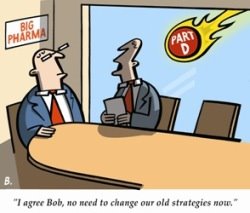 Now that we are "new millenials" and deep into our Great Media Evolution, strategy, marketing and media are still the essential tools for successful business. To use those tools effectively and achieve strategic "victory", business needs to know its new target, which is constantly moving. Dependent on market conditions, consumer demands and brand image perceptions shift, erode, grow or die. New media times require new strategies.
In the past, marketing was unsophisticated. To reach the masses, marketers could "carpet-bomb" campaigns on TV, radio and newspapers. Consumers had fewer media options so this strategy worked because marketing messages could reach nearly the total population. After all, "carpet-bombing" worked as a military strategy. However, just as war's evolution now requires the use of "smart bombs" instead of carpet-bombs, marketing strategy has evolved, too. As "The Economist" recently wrote, marketing is now about small, not large, audiences. New millenial marketing requires multi-platform sub-niche strategies that precisely reach their intended target. As author Seth Godin says in Purple Cow, being safe and boring is risky. Look at radio, look at NBC (and most of the cable channels), look at the advertising in any newspaper. Safe and mainly boring, not compelling or remarkable. When do billboards work? When they tease or boldly break beyond their rectangular dimensional space. To get heard through all the noise and clutter, today's marketing messages, programming and products need to be remarkable. There is no mass media anymore, just lots of free-wheelin' micromedias -- some with larger audiences than others.
Be remarkable, not safe and boring. And target the remarkable consumers best for you, not just the massess. How is that done best?
Segmentation, for starters.
You have to know your market and know what links the customers driving that market...the customers with influence. What is segmentation? In layman terms, segmentation determines -- through market researched statistical techniques -- unique sub-groups of people with common likes and dislikes within a larger customer population. For example, in TV, some people just like comedy; others may only prefer news and talk shows. The list of different TV segments is long. Same thing for radio, music downloaders, e-zine readers and bloggers, and the rest of the multi-media universe. What's important is learning each segment's (or sub-group's) commonalities, demands and attributes...what makes them different than the rest of the target population...and how they impact or determine various business strategies.
Essentially, proper segmentation gives marketers precise targeting in order to achieve successful strategies. In this hyper-competitive time for media companies, effective market segmentation is the #1 information advantage for the battle of today's consumer minds, whether you are on-line, over-the-air, wireless or in-print. Why? Because so few companies make the investment to segment properly. Too complex, costs too much, no budget and other excuses. If segmenting is done, it is done rarely. It is all too common for companies to segment only once in 4 years (if at all). This is true in all media platforms, mainly because of cost issues and an expectation that markets don't shift that much in 4 years.
Really? 4 years ago, the iPod and iTunes (still only for Mac users) was just getting hot. Broadband was in less than 4% of American homes. No cable system had HD digital delivery systems. Satellite radio was brand new with virtually no subscribers (which now are more than 10 million). In 2002, words like "blog" and "podcast" were pure geek science. ESPN and other networks now send custom programming to be viewed on cellphones. Think the media universe and how consumers use media hasn't changed much in 4 years?
Do you think target segments have remained the same? Think again.
Nowhere is segmentation most dramatically under-utilized than with web analytics. Strangely, with the amount of natural data constantly collected with web usage, you'd think that segmentation would be a given. But it's not. A recent JupiterResearch study found using Web analytics to target e-mail campaigns can produce nine times the revenues and 18 times the profits of broadcast mailings. Yet the same research says few marketers are using segmentation techniques.
The same is true for all companies utilizing media for their marketing, programming and content distribution. Consumers typically use media -- in one form or another...or several at the same time -- for nearly half of every 24 hour day. Reasons for the lack of segmentation, in general, are clear:
1) Marketers (and the people responsible for putting marketing decisions into action) are suffering from tactical information overload (you name it, we all can get instant time media reports on deliverables),
2) Multi-tasking "do more with less" marketers are trying to do great things with little time and few resources (creating less than great results),
3) "Fix-and-run" decision makers can't slow down long enough to process the meaning of segmentation and how to effectively use the information,
4) Segmentation is still viewed as an investing luxury, not a necessary cost of wisely doing business to gain advantage.
As mentioned earlier, whether you are on-line, over-the-air, wireless or in-print, segmentation is the #1 information advantage for the battle of today's consumer minds. If you're not segmenting every year or so, you are missing a huge competitive advantage and probably wasting revenue on ineffective marketing campaigns. So, how can you start using segmentation? Well, for starters, you can contact us at Joint Communications. We've been market segmenting since 1977, helping media companies around the globe win their perception battles with words, ideas and disciplined thinking...and successful strategic results.
posted by Unknown @ Friday, June 30, 2006,
,
Modern Media Catch-22: Report finds sex always on men's minds...yet cellphone may be damaging sperm production
Labels: Jointblog Apparently, as I am writing this Jointblog post, what I am really thinking about is sex. And here I thought I was focused on a worthy topic about branding, audience building, media trends, market research and ratings victories.
You know, media stuff.
Well, according to a new medical study, maybe I wasn't after all.
Then again, yesterday's British article scientically stating that cellphone usage hampers quality sperm production gets you understandably thinking. It's news to pause anyone's swimmers.
I better set down that cellphone and keep those high-energy lithium batteries away from my sensitive areas. Meanwhile, the iPod celebrated its 5-year birthday Monday...but wait...Don't those have intense batteries, too? Can't we have it all? The iPod, the cellphone AND the great sex?
It's the modern tech age example of Catch-22. Use new tech gadgets to connect at the risk of limpy sperm. Is this an underhanded conspiracy plot to keep western culture populations in decline?
Just what are those batteries doing to us when we keep our iPod or cellphone (or other PDA) on our hip or front pocket for hours every day?
The United Press International reports:Researchers at the Kinsey Institute for Research in Sex, Gender and Reproduction at Indiana University say most men are always thinking of sex.
Well, if these batteries are going to affect our sexual performance, at least we can use the Internet to download whatever to help us out. The spam I still get (despite blockers) tells me so, anyway.
A study released Tuesday in the journal Proceedings of the National Academy of Scientists found 54 percent of men and 19 percent of women admit they think about sex every day -- or several times a day -- in a society where they are bombarded with subconscious erotic images.
Scientists at the University of Minnesota found sexy subliminal images competed for attention in the brain even when the images were not right before a subject's eyes and most people are not consciously aware of them, ABC News reported.
Researchers also found sexual orientation often determines how the brain reacts to erotic images. Heterosexual women, for example, were more tuned in to pictures of naked men, the same reaction exhibited by homosexual men. But homosexual woman were equally attuned to naked images of both sexes, the report said.
Reference article here
posted by Unknown @ Tuesday, October 24, 2006,
,
Satellite Radio Barely Reaches Earth

(from the Center of Media Research/Mediapost.com)
Bob Jordan, president of International Demographics, said "We were surprised at how little market penetration has been achieved by satellite radio," after reviewing the results of a Media Audit survey in 87 metropolitan markets. With a collective adult population of 137,478,000, satellite radio has attracted a mostly male audience of just 681,000 or 0.5 percent of all adults in the markets surveyed.
Some of the findings of the study include:
* The demographic profile of the satellite audience is affluent and well educated
* More than 73 percent of all satellite listeners had household incomes of $50,000 or more, but that 73 percent represents only 0.8 of all households with incomes of $50,000 or more
* Approximately 63 percent of satellite listeners are men and 55 percent have at least one college degree
* 76.1 percent of all adult listeners are 35+ and 48.5 percent are 45+.
* Over 29 percent of satellite listeners fall into the proprietor/managerial classification
* 17.3 percent fit the professional/technical category
In the 87 markets surveyed, satellite radio attracted only 10,000 or more adults in just 20 of the 87 markets surveyed. The largest number attracted, 76,000 was in New York City which is a market of more than 14 million adults. Satellite only pulled one percent or more of the adults in just six markets and in no market did it attract two percent.
According to a recent Forrester Research study, says the report, satellite radio will have 20 million listeners by 2010. Jordan says "... even that number seems disappointing. News-Talk format in traditional radio that draws more than 19 million listeners just in the 87 markets covered, while Clear Channel stations in the same markets attract more than 48 million listeners..."
Jordan concludes by saying "Satellite radio is competing with a product that is distributed free, and that's a heck of a price disadvantage."
posted by Unknown @ Wednesday, June 08, 2005,
,
Study: Metro Papers' Sites Build Following

(contributed by Adweek's IQ Interactive) A new report by Internet media and market research firm Nielsen//NetRatings finds that the country's major metropolitan newspaper Web sites have built up a loyal following in their local markets.
On average, the top local newspaper Web sites reached 19.5 percent of a city's active Internet audience across the top 10 local markets studied during July 2005.
WashingtonPost.com led the way with a 30.1 percent reach of its local Internet users, followed by Boston.com (28.3 percent) and AJC.com (26.4 percent). NYTimes.com and ChicagoTribune.com round out the top five, attracting 21.9 percent and 21 percent of their area's Web users, respectively.
Out of the top 10 local markets studied, Philadelphia was the only exception to the trend of local newspaper dominance.
USAToday.com reaches 9.6 percent of online news readers in Philadelphia, barely edging out Knight Ridder's Philly.com, the Web site for the Inquirer and Daily News, which attracted 9.2 percent of the same audience.
"City newspapers have successfully built an effective online presence as the source for local and national news," Charles Buchwalter, Nielsen//NetRatings' vice president of client analytics, said in a statement. "Newspapers have broadened their reach by growing their audience's news consumption from a print-only readership to an online edition, knowing that Internet-savvy users are sometimes only consuming news online."
Additionally, the study found that NYTimes.com, WashingtonPost.com and LATimes.com had the greatest national reach out of the No. 1 local market newspapers. NYTimes.com has a national reach of 9.3 percent, followed by WashingtonPost.com's 5.7 percent and LATimes.com's 3.1 percent. USAToday.com reaches 7.1 percent of the national audience.
The study's findings, released Thursday, were derived from the new Nielsen//NetRatings MegaView Local service, which combines survey results with actual surfing habits.
posted by Unknown @ Friday, September 23, 2005,
,
Media Trend Watching: Radio Right Now
Labels: cellphone, FMQB, Google, HD Radio, Internet, John Parikhal, Joint Communications, Jointblog, Karmazin, Media, Media Trend Watching, MySpace, PPM, Radio, Sirius, XM Joint Communications marks 30 years this month advising the radio industry through format programming, consulting, market research, marketing development and media strategy services.
The month of April also means it's time for John Parikhal's annual spring check-up as this week's featured FMQB cover story to discuss radio and the evolving mediaspace challenges radio faces in the immediate future.
Among the discussed topics:
> The proposed XM/Sirius merger -- including the financial and competitive implications as well as Mel Karmazin's catalyst role (puzzling; Stern probably helped save Sirius; Mel sees opportunities)
> The trend led by Clear Channel and other big groups toward privatization (more squeeze and bleed? And Clear Channel gets rewarded?)
> HD Radio (just another local spectrum)
> PPM ratings measurements (consistency of measurement will help)
> The cellphone (risky for electronic ratings measurement)
> Blink spots and other "Less is More" initiatives (applaud the experimentation; spare listener energy; don't invade the consumer)
> Radio's needed presence on the Internet and its mishandling of opportunities that went to MySpace instead (getting better...but still behind due to insufficient support staffing and streaming fee penalties)
> Google's new deal selling radio ads ("It's nonsense")
> The lucrative potential of selling and targeting the 30-59 year old demographic (so much money radio could grab)
> An updated look at radio's emerging trends (demographics!)
FMQB's chief editor Fred Deane gets it all started by saying:As the radio industry evolves at a rapid pace, critical decisions about the medium’s future become increasingly more urgent. Technology issues have enveloped the industry to such a challenging extent, that the call for radio leaders to be actionable has never resonated so loudly. John Parikhal has never met a challenge he didn’t like, he relishes the very concept. While Parikhal’s client list continues to remain firmly entrenched in radio, the macro version finds him involved with a variety of media and marketing companies. His latest foray with strategic Internet initiatives with some large clients has him thinking about the future 24/7. It’s spring and time for our annual check-up with one of our industry’s deep thinkers.
Thanks, Fred. All that and more...just click here for some great reading. Then come back and add your thoughts here on the Jointblog.
Additional reading: Thinking Through The Decision Making Process
posted by Unknown @ Friday, April 27, 2007,
,
Instant Messaging equals Instant Feedback
Labels: Jointblog Instant Messaging equals instant feedback, whether between person-to-person to person-to-community.
For decades, broadcast radio was a leading place for a community to give and get instant feedback. Live feedback. Call in a request. Ask the DJ about some gossip. Respond to a talk show issue. Find out about the weather, traffic or when your favorite band's new album goes on sale.
Instant text messaging is another form of feedback. An information exchange.
Last month the Jointblog pointed out that teens prefer IM over email. Increasingly, there is a generation gap between teens and adults using IM -- the cool kids who do and the don't-get-it grownups.
A new AOL-AP poll says almost half of teens, 48% of those ages 13-18, use instant messaging. That's more than twice the percentage of adults who use it.* Almost three-fourths of adults who do use instant messages still communicate with e-mail more often. Almost three-fourths of teens send instant messages more than e-mail.
The way teens and adults use "instant feedback" in this digital era is very different. If you email, you're probably a grown-up. If you text, you're probably a teen...it's that clear-cut.
* More than half of the teens who use instant messages send more than 25 a day, and one in five send more than 100. Three-fourths of adult users send fewer than 25 instant messages a day.
* Teen users (30 percent) are almost twice as likely as adults (17 percent) to say they can't imagine life without instant messaging.
* When keeping up with a friend who is far away, teens are most likely to use instant messaging, while adults turn first to e-mail.
* About a fifth of teen IM users have used IM to ask for or accept a date. Almost that many, 16%, have used it to break up with someone.
This mirrors radio's disconnect with teens. Not only does radio intentionally avoid providing teen-targeted radio stations (despite the massive impact teens have on consumer product spending and overall trend setting for the masses), radio has also been slow to tap into the power of IM text messaging. Yes, some stations provide online opportunities for "instant feedback" through email and even open AOL, MSN or Yahoo IM accounts so jocks or hosts can "talk" with listeners live during a show. Very few stations really tap into IM's potential, though.
IMing is immediate customer feedback. It's data. It's information from radio's most active users. That means it is part of a radio station's market research on its biggest fans.
Most stations know nothing of their existing "instant feedback" customer details. Nor do they explore further to build that direct relationship. There are quality services available.
Why do radio listeners contact a radio station to ask a question or express an opinion? Because they want to be heard.
Are radio station hearing their own listeners? Are they even listening to the right listeners?
posted by Unknown @ Sunday, December 10, 2006,
,
Finally, Mancow is out of Q101
 Mancow is ManToast at Q101 in Chicago. Nothing personal...but his run is done. After an eight year run doing mornings, which led to Mancow building a network of syndicated stations for his show and fueled a long-running on-air fued with Howard Stern, Mancow's flagship has let him go.
Finally.
Yes, his show brought Q101 a version of "success"...but it cost the station far more than it earned. What used to be THE original "new rock alternative" station in America -- spawning dozens of copycats hoping to get a taste of Q101's strong ratings pre-Mancow -- is now just another starved Alt Rock station gone stale, a victim of misdirected strategy and an exhausting, lengthy competitive attack. What used to be a 4-to-5 share radio station is now mired with a 2 share or less...even lower when you take away Mancow's morning ratings.
Back in 1991 and 1992, Q101 was one of several has-been adult contemporary radios going nowhere. They had a million dollar morning show with Robert "Murphy in the Morning". And nothing else after his show. So they hired Joint Communications to help them figure out a new format direction -- one that would be compatible with their morning show (with its lengthy contract). Doing advanced market research, we identified Q101's opportunity and helped them create the strategy: an "AC" version of Modern Rock, which later was dubbed "New Rock Alternative". In Chicago, at the time, there was a sizeable audience of both women and men who liked to Rock and who'd listen to a new station if it played WXRT's gold Modern Rock along with the current Alt Rock sound still being shaped by bands like Nirvana, Pearl Jam and Stone Temple Pilots. What made Q101 unique at the time was that Q101 actually targeted women who loved New Rock Alternative; they knew the men would come anyway. They kept that strategy for 4 years, leading the way for breakthroughs from Smashing Pumpkins, Tori Amos, Alanis Morissette and Sheryl Crow...and anything grunge before grunge even had a name.
Then, they made the decision to go male- instead of female-targeted. Against the core essence of the station strategy. This opened the way for estrogen success from new "Pop Alternative AC" Mix WTMX as Q101 went harder and more testosterone. Ratings for Q eroded, talent left or were fired, and a new competitor The Zone came in to further worsen Q101's ratings performance. Although Q ultimately outlasted The Zone, the damage was done -- Q101 was a shell of its former self.
That's the local effect. Nationally, Q101's move to a male-target may have been most responsible in killing the Alt Rock format on the radio. At the time, Q101 was the leader for the Alternative nation; its influence was strong. It reinvigorated KROQ in LA and inspired the launches of 99X in Atlanta, The Buzz in Houston, The Zone in Phoenix, The End in Seattle, dozens of "New Rock Alternatives" across the country, and even the format change of Howard Stern's flagship station in NYC on K-Rock from Classic Rock to Alt Rock. Q101 showed radio executives that money could be made. A lot of money.
However, what the other stations (and the record labels) didn't realize was the importance of women New Rock Alt listeners within the success equation. And that it had a specific local design. Once Q101 gave that up design strategy and went male...bringing in more "edgy" Alt and Rap/Rock and finally reshaping the station into a Mancow-friendly station, the downslide of New Rock Alternative began.
Q101's move 10 years ago rippled throughout the industry, followed like lemmings by dozens of stations. Today, when you google "Q101 sucks", you get almost 10,000 links. All from this one local Chicago station.
Q101 used to be be an innovator. A pioneer for the format. A great station. Getting rid of Mancow is a good thing. Now the question is: can they return to their innovative roots and revive the New Alt Rock format again?
posted by Unknown @ Tuesday, July 11, 2006,
,
What is media trend watching?
 A media trend watcher connects the dots of emerging trends. Takes note of media catalysts, happenings and decisions that potentially create a larger impact later. Explores the ever-deepening digital landscape, seeing how it forces all media platforms to evolve.
A media trend watcher participates. For example, by conducting market research, observation and media strategy implementation, you are a media trend watcher. By monitoring ratings and usage performance and then relating them to past results, you are media trend watching. Sharing ideas and participating on this Jointblog as well as others with your commentary responses to posts contributes to media trend watching. Drawing inferences from one media insight to conclude something new. Media trend watching reviews the tactics of something newsworthy today and pieces together the long-range strategic direction. For example, the Jointblog views "truthiness" as a strengthening media trend, which is why we reference The Colbert Report so often. Taking the 30,000 feet view, truthiness truly is the descriptive word of the decade. It applies to politics ("Saddam and weapons of mass destruction with ties to bin Laden", "A heckuva job, Brownie" or "Mission Accomplished"), business (Enron, Tyco, Adelphia, oil price vs executive compensation), entertainment (reality TV is not reality, news teasers during sweeps focusing on fear tactics on matters that really have near-zero likelihood of ever affecting your family) and the Internet itself (the rise of the blogosphere as well as the issues of net neutrality, identity theft, and copyright protection and royalties). As a media trend, if 9/11 killed irony, truthiness certainly filled its void.
 There are so many other media trends to watch. Traditional media slow acceptance of the on-demand New Entertainment Economy, unwilling to give up its "push" model of control and ownership, is certainly a strong one. Nearly 50% of Americans now have access to high-speed broadband connection to the Internet, either at home or at work. Americans want stuff fast, easy and at a reasonable price without hassle. They want to choose the content and not have the content chosen for them. They want to pull media; they are tired of having media pushed at them with little or no choice. More and more they resist or simply ignore content -- on radio or TV as well as with other traditional forms of "mass" media -- that doesn't suit their real need. The result for those companies resisting? Smaller reach and frequency of usage, less time listening and viewing, reduced subscriptions, zero or negative word of mouth.
Media trend watching takes items that may seem like a small story and shows the bigger view. One trend I hope takes hold is simplicity. As a society, we are all overwhelmed with too much noise, too much stress, too many expectations. We have decision overload. And yet, so much of what we doing as media professionals is add to the noise, add to the stress, add to the expectations. As much as we try to create solutions, we often present more problems. Because we don't make it easy for the customer. We waste consumer time with useless contests or promotions that add zero value. That aren't fun or compelling. That require we jump through too many hoops. We bombard consumers with advertising that doesn't connect with the reader, the listener, the viewer -- expecting the customer to pay attention. Often, content looks good for advertisers but not for the audience.
In fact, as a media trend, it is the audience or the target consumer base that is often the last component considered for many media plans...if they get truly considered at all. Of course, at least conceptually, they should be the first compontent. One marketing campaign of the last 5 years that impresses me is the Staples "Easy Button" campaign. After 15 years of growth, Staples began to realize their customers were getting more and more dissatisfied. Finding the items they needed while shopping was difficult. Customer service provided no help at all. Staples was in danger with losing their base and revenues were dropping. After honest reflection, they saw opportunity in their crisis: make it easy for their customers. Don't make it complicated. Get rid of the distractions and useless products that their business supply customers never needed in the first place. Retrain their customer service sales people to actually help, directing shoppers to the exact correct aisle and shelf location for the products they sought. Once they fixed their operations, they then marketed something that rang true: The Simple Button. Press the button and voila, it's done. Easy and simple. That's the Staples experience now. They listened to their customers and changed their ways to meet the demand in a new competitive environment.
The campaign launched 3 three years ago and immediately propelled Staples to new growth, strongly outgaining their competitors in revenue, profit and share. It even created strong positive word of mouth...including the crazy demand from customers actually wanting to buy Easy Buttons for their own desktops at work. Staples quickly responded and made them available for sale, generating charity contributions of $1 million a year.
Simplicity.
Truthiness.
Just some of the media trends we are watching. Are you a media trend watcher? Write to us. We welcome your participation...just add your comments to our posts or forward us your own observations. We thank you for media trend watching with us.
posted by Unknown @ Monday, June 19, 2006,
,
The problem with Jack FM: "That's Not My iPod"
 The corporate radio trend of "Jack FM" (and all the clones) seems to be on the wane. For the past 3-4 years, radio stations have been jettisoning heritage formats that were deemed either to be under-performing or having weak future potential to increase ratings and revenue. In place of the old format (usually Oldies), a "new" format intended to capture the huge "variety" found on individual iPods. Jack, Bob, Mike, Ben, Dave...they all try to position themselves as the "We Play Anything" local radio station. "No downloading required." "We play want we want." "We take requests...ours."
Nationally, these formats popped up first in Canada -- some with huge success, some not. The US picked it up a couple of years ago. Again, some hits, some flops (kinda like how the format actually sounds with the songs that are played). 2005 seems to have been the peak year for these format flips...there really hasn't been much new action since CBS Radio's flips in Chicago, LA and New York last spring and summer. Like in Canada, the US entries have a mixed bag of success (with a lot of disappointing results). Some don't have live DJs, some do. They all try to play a wider range of music styles than most other narrowly-programmed commercial radio formats which forgot how to program with passion and listener surprise decades ago. One common result: a lot of people saying Jack is not like "my" iPod. This seems particularly true in market research as well as with online blogs and radio fan forums across the country. Sure, some markets love Jack's dry "I'm an ass...you're going to listen to me and like it" personality and ratings zoom huge. In their own way, they like how it "sounds" anti-corporate. In some markets, though, Jack just sounds like an ass and a complete corporate lie.
When launched, Jack tries to attract the "whatever" crowd. After not much time at all, many listeners start to say, "Whatever, later." And that is happening more and more lately.
Last August, my favorite newspaper (and "America's Finest", or so it says) The Onion published a story by a writer saying how his local Jack was not the iPod he was told he was getting. It's an achival story...but it still resonates, especially as the Jack movement may be on the quick downslide...
posted by Unknown @ Friday, April 14, 2006,
,
Grups are cool...and Has Our Celebrity Culture Peaked?
 Pick up a copy of this week's New York magazine or check it out online here. Excellent reading pointing out some media trends to watch. Two feature stories grabbed me. One ("Up With Grups") legitimized my fashion and style sense, explaining how we 40-year olds still rock it in our 20-something gear. Even came up with an updated description of our Gen X selves: Grups (we Star Trekkers understand the reference). Also, how our Grup resistance to growing-up in the image of our Baby Boomer parents has helped close the generation gaps with our own children (we "Grups" do rock). On the worry side, though, if our teen kids form their own style opposite of their Grup 'rents, are we just creating a new generation of future Republican prep namby-pampbys?
 The other feature article asks "Has America's seeming insatiable appetite for celebrity finally begun to cool?" Well, "maybe" it has. Kurt Anderson observes that many cultural barometers have pointed down lately (magazine circulation and subscription figures are down for many celeb mags; can anyone say oversaturation?). Meanwhile, the gossip mags (like the Enquirer) are also down. Ratings on TV are down, too. Interestingly, all the recent market research we do at Joint Communications shows that the demand trend for enternatinment news and gossip is way down and among the weakest of programming items. People magazine -- launched in 1974 -- is considered the epicenter for today's modern celebrity watching; sales are also down.
Have we finally reached the down-curve of celebrity gawking the likes of Paris Hilton, Lindsay Lohan, Angelina Jolie, Jennifer Anniston and hundreds of other so-called pop-culture stars? One can only hope. As Anderson says:"The Nielsen ratings for this year’s Oscars were down 8 percent, and for the Grammys 11 percent. During the last half of 2005, the Enquirer’s newsstand sales were down by a quarter and Entertainment Weekly’s by 30 percent. The American OK! is said to be unwell, the magazine Inside TV was launched and killed last year, and a magazine called Star Shop was killed before it launched. Like other American social tides, the fascination with celebrities has been cyclical, and after several decades of rising (as it also did from the twenties through the forties), perhaps it will now (as in the sixties) ebb."
 Meanwhile, I'll be waiting for Grup-favorite FHM's April 4th issue featuring the newly-annointed "Sexiest Woman in the World" Scarlett Johansson...
posted by Unknown @ Tuesday, March 28, 2006,
,
Super Sunday Ratings
 ABC’s broadcast of the Super Bowl XL drew a bigger audience than last year, despite early estimates that the game would come in below last year's broadcast on
According to an ABC spokesman, quoting Nielsen Media Research Fast National numbers, the game drew an average of 90.72 million viewers, compared with the previous year’s broadcast on Fox that pulled in 86.1 million viewers. Super Bowl XL drew a household rating of 41.6 and a 62 share, and in the 18-49 demographic drew a 34.6 rating. (A rating is a percentage of households watching a broadcast.)
In local markets, the game drew a 57.1 rating in Pittsburgh, home of the winning team, the Pittsburgh Steelers. In the Seattle market, home of the losing Seattle Steelers, the game scored a 55 rating while viewers in Detroit, the host city, pushed the game to a 52.3 rating.
ABC is also touting the huge ratings success of the network’s post-game entertainment. Hospital drama “Grey’s Anatomy” reached 38.1 million households. That figure is the largest audience for post-game entertainment since "Survivor 2" broadcast on CBS in 2001.
Last year’s matchup between the New England Patriots and the Philadelphia Eagles drew 86.1 million viewers, according to Nielsen Media Research, for a 41.1 household rating for Fox. That figure was down from 2004, when 89.8 million viewers, or 41.4% of U.S. households, tuned in to see the Patriots and the Carolina Panthers on CBS. The now infamous telecast featured the Janet Jackson halftime show wardrobe malfunction.
According to A.C. Nielsen, the most-watched Super Bowl in the past 10 years was the 1996 contest between the Steelers contest the Dallas Cowboys (the Steelers lost that game). That game drew 94.1 million viewers, for a 46 rating. The 1982 Super Bowl was the most-watched of all time, with a rating of 49.1.
Source: AdAge; Nielsen Media Research data
posted by Unknown @ Monday, February 06, 2006,
,
National Public Radio: Airwaves for the people make a great American success story
Labels: Radio Quick: what's the leading morning radio news program in the United States?
At first, you might think your favorite local All News commercial station. WINS-AM, WCBS-AM in New York; WBBM-AM, WGN-AM in Chicago; KFI-AM, KABC-AM in Los Angeles; KGO-AM in San Francisco all quickly come to mind. Each of these stations have a million or two regular listeners during the week. However, all of those stations pale in audience reach compared to America's radio network: NPR.
And America's #1 morning radio news program?
Morning Edition. You know it. You've probably listened to it. And you may even have its coffee mug after making a contribution. Fox News may bombastically push its patriotism in your face. And the Colbert Report may sarcastically flagwave with mock satire right back at Fox exposing their idiocy with a smile and the proud "chaw" sound of an American bald eagle behind him in support.
But it's NPR that really gets liberty right.
Informative and real. Open. Unbiased. Fair...without fear tactics. And without commercials. What's not to love?
It's the one dependable media space for "middle America" -- where moderates and centrists gather with tremendous loyalty.
For most of its existence, National Public Radio has been one of media's quietest success stories. For all the crazy excitement about new technologies for radio -- internet streaming, cellphone streaming, satellite, HD Radio -- NPR has just kept on doing what it does best: inform and educate the American public with topics and news that helps its listeners understand the world a little better.
Since NPR's founding in 1970, it has become a dominant intellectual and entertainment force in American life and a primary source of news for millions. NPR programming is heard on more than 800 independent public radio stations. It's not commercial -- it's funded by taxpayers and individual donations. In the crassness of this commercial radio age -- with every possible part of programming squeezed for optimal revenues to please Wall Street, NPR sounds like (and often is) a charming oasis of basic Americana minus all the hype. And yet, because it is ignored by commercial ratings services (Arbitron) and it doesn't have the marketing budgets of the commercial broadcasters, most whom think of radio categorize NPR as a separate media, even though it shares space on the same radio dial as commercial radio.
Get this: the audience for NPR programming has doubled in the last ten years to 26 million weekly listeners. Since Fall 2000, the audience to NPR programming has added nearly 8 million listeners, an increase of 40 percent. In the early 1980s, only about about 2 million people listened to NPR.
That's huge growth...all under the radar. More and more in the last decade with Joint Communications research, we have seen NPR stations play an important role for understanding competitive market dynamics and audience sharing. Often, some formats (such as Modern Rock, Triple A and Oldies) have a high level of audience sharing with the local NPR station.
According to a new study from The Media Audit and IPSOS -- which did a telephone survey with 114,035 adults across 84 cities in 2005 and early 2006, National Public Radio is the 4th most listened to radio format in the country.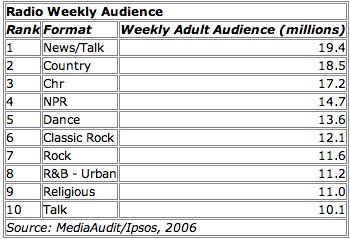 The big difference: NPR is a national network truly broadcasting its format across the nation (as well as the world through new media partnerships and internet streaming). The leading commercial formats -- led by News/Talk -- broadcast their formats individually, unique to each market.
While NPR is not a big factor in terms competing for advertising dollars, it is a major factor in some markets for gathering large audiences completely unavailable to commercial radio. It's a reminder for commercial radio programmers to know their entire competitive landscape.
Don't be surprised if NPR suddenly pops on your radar. As a media trend, NPR airwaves to the people have made a great American success story.
posted by Unknown @ Thursday, August 10, 2006,
,
Billboard Radio Monitor Roundtable: Radio Vs. The iPod
 A couple of weeks ago, Billboard's Radio Magazine invited several leaders from the radio industry to talk about the current state of the radio industry and how radio can better compete against new media/digital threats. iPods, how to target today's youth market, new technologies radio should embrace and other opportunities and threats were all discussed.
The conclusions: Technology may not be the enemy. A challenger at times, certainly, but not the competitive antagonist that many inside and outside the radio industry have made it out to be.
In fact, with high-definition side channels, podcasting and re-energized radio station Web sites, technology has become a requisite collaborator in terrestrial radio's ongoing battle for increased market share, brand extension and revenue building.
While iPods, Internet music destinations and satellite radio present a threat to broadcasters' quest for consumers' time, the medium's own arsenal of technology-driven tools will lead its charge into the future. Joint Communications Corporation's CEO John Parikhal was among the seven industry leaders who gathered Jan. 19 at Billboard Radio Monitor's headquarters in New York, along with executives from Clear Channel, BigChampagne, Greater Media, Edison Media Research, CBS Radio's news WINS New York and Emmis' R&B/hip-hop WQHT (Hot 97) New York.
UPDATE: Now you can download or view the streaming video of the discussion by clicking here.
Among the quotable highlights:"Radio has been attacked from a lot of sides, but it's held up to videogames, satellite radio and iPods," said Buzz Knight, VP of content development for Greater Media. "There are significant challenges ahead, but there's room for optimism. It's a very exciting time."
Tom Poleman, senior VP of programming for Clear Channel/New York, added, "We have an opportunity to reach consumers in new and different ways with the technologies that are out there." With HD side channels, podcasting and on-demand video platforms, "this is an exciting time for radio. We need to ride the wave."
"You don't try to educate listeners; another kid does," said John Parikhal, CEO of Joint Communications. "No matter how much we want people to pay attention to us, a filter goes up. They're spending 70 hours a week with media in an overcommunicated world. If the product is good, they'll eventually pay attention to it."
WINS VP/GM Greg Janoff added, It's about building community and getting listeners to tell their friends about it. Radio is not dead; it just has to reinvent itself. We're the original community builders."
More from John Parikhal: "Radio has never really invented anything—it does a brilliant job of packaging what's already out there. What the industry needs to do is accelerate the rate at which talent gets to radio. Spend the time to train people who want to bring stuff to the medium. Take everything we know about formatting and packaging and teach it to people who want to be on the air, through podcasts. Use formal training methods, and you'll find talented people who could be really good if only they knew how to do radio."
Joe Fleischer, principal of BigChampagne, which tracks traffic on illegal file-sharing platforms, added, "The music industry now realizes that they're not in the business of selling plastic discs anymore. They're now selling content. Unfortunately, they missed the biggest transition since vinyl to CD by three years. Now it's up to them to figure out how to work with everyone that needs content."
One more from John Parikhal: "One of radio's great strengths is repetition. There's nothing worse for a listener than a song that he or she doesn't recognize. It's a balancing act between comfort and introducing new music. The problem for radio today is that young listeners are getting their new music from friends via" instant messaging.
To read the rest of the article, click here
posted by Unknown @ Monday, February 06, 2006,
,
Closing In On One BILLION iTunes Music Store Downloads....And That's Not All...
 14 million new iPods were sold over the holidays (3 to my immediate family alone). So far, iTunes counts over 850 million song downloads. At their combined sales rate, Apple should hit the 1 BILLION song download mark by sometime this spring. Who will get credited with THAT historic purchase?
Adding to that news (iPods are selling 3 times faster now than there were a year ago and it's expected to keep getting hotter), it was also announced Apple Computers has begun siphoning customers from the Windows camp. After years of hovering around 3 percent, Apple last year cracked 4 percent of the U.S. PC market. And that was done before the release of the brand-new iMacs and Powerbooks powered by the ultrafast Intel double microprocessors which are 3 times faster than any other PC chip. The result?
Apple shares leapt to an all-time high on Wednesday, boosted by its decision to unveil 6 months earlier than expected its first two machines with Intel's Core Duo. Here's the most amazing news, despite the impressive new chip processing performance: Apple said it would not thwart users who would seek to run Microsoft Corp.'s Windows operating system on the machines. With Intel processors inside the new Macs, their owners could run Microsoft Windows and software designed for it at full speed. So, people will get a choice...they can run a Mac with full Windows usage OR with with regular Mac OS X software.
"Now consumers can buy a Mac that is three times faster and for the same price," said Nathan Brookwood, an analyst with Insight 64 research firm.
Apple shares soared $3.04, or 3.8 percent, to close at a split-adjusted record high of $83.90 on the Nasdaq Stock Market Wednesday. It's increased 10% just in the last month.
full story
posted by Unknown @ Wednesday, January 11, 2006,
,
The buzz at CES: What's Google and Microsoft up to?
 GOOGLE EXPECTED TO ROLL OUT BIG, NEW INITIATIVE; meanwhile, Time Co-Person/Good Samaritan of the Year Bill Gates Gets Spotlight
The buzz is all about Google at this week's Consumer Electronics Show in Las Vegas.
With more than 2,500 exhibitors hawking their products and services in 1.5 million square feet of convention space, the annual consumer electronics show has become the place to influence the industry and impress the public.
Rumor control is already working overtime as reports surfaced Tuesday that Google will announce something dramatic -- a Google PC, maybe? -- when he addresses the CES later this week.
"People have been speculating about things like a Google Web browser or Google operating system," said Michael Gartenberg, vice president and research director at Jupiter Research.
Google spokeswoman Eileen Rodriguez quickly shot down a report that the Mountain View company planned to sell a low-priced personal computer through Wal-Mart Stores.
"We have many PC partners who serve their markets exceedingly well, and we see no need to enter the market," Rodriguez said in a statement.
Whatever it is, Google's announcement could upstage the Consumer Electronics Show's traditional stars -- Microsoft's Bill Gates, Intel's Paul Otellini and scores of other tech industry leaders who make the pilgrimage to Las Vegas every year to publicize their products. Speaking of Bill Gates... Microsoft Chairman Bill Gates often likes to use the CES to unveil high-concept gadgets running Windows software.
But Gates stepped to the podium in Las Vegas last night with a higher calling: to pitch Windows itself.
What's on his mind for 2006 and Microsoft?
"2005 was a big year (for Microsoft). 2006 will be an even bigger year, with Vista coming out and Office 12 and the realization of the Media Center PC as a mainstream product," Gates said.
More from the CES to come...
full Google/CES story
full Bill Gates/CES story
posted by Unknown @ Thursday, January 05, 2006,
,
Web Video Ad Spending to Double in 2 Years
 According to Adweek.com, Internet video spot buying is set to more than double by 2007, spurred by increasing numbers of homes with broadband Internet connections and an improved selection of programming from big-name media companies, according to a report.
New York research firm eMarketer pegs the online video ad market in 2005 will generate $225 million. It expects spending will rise to $640 million in 2007 and $1.5 billion in 2009.
Broadband penetration is driving the market, the report said, with 42.3 million U.S. homes going online via high-speed connections, a 23 percent increase from last year. In 2007, eMarketer forecasts 60.4 million households will have broadband. While half of Web-connected U.S. homes now have broadband connections, eMarketer expects half of all households will have it by 2008.
AOL, Yahoo, Viacom and other media companies have increased the amount of video content available online this year. This expanded choice in programming, combined with high-speed connections that make viewing it possible, has resulted in increased viewership, according to ComScore Networks. It tracked streaming video penetration rising from 55 percent of Internet users in March to 61 percent in August.
posted by Unknown @ Tuesday, November 29, 2005,
,