

Avoid Work Overload and Negotiate Your Expectations In Advance
Earlier this month, Fred Jacobs of Jacobs Media published a blog post talking about the importance of DJs and station staffers stepping it up to provide more value to their stations...reinforcing the idea of individual “indispensability,” a concept popularized by Seth Godin in Linchpin. Labels: Jacobs Media, John Parikhal, Joint Communications, Negotiate, Overload, Self-management
This post also attracted a lot of responses and retweets, including comments submitted by Joint Communications' President and founder John Parikhal.
The Jointblog agrees it was also worthy to post. Here it is complete...our thanks to Jacobs Media:

Like many of us, John is adapting and evolving, forming a partnership with renowned business expert Philippe Denichaud. As John notes, “Peter Drucker and Philippe are my biggest management influences. From them, I learned how to apply practical strategies to help businesses survive and grow.”
Today, we get a great lesson from John:
Great article, Fred. It’s a good list for any hardworking employee to think about.
The tough thing for a lot of people is that they will work harder, show up earlier and do all the extra crap jobs – and still get fired.
Here’s how to avoid this fate (or at least reduce the likelihood):

For example, how much does the station value a speech at a local high school or business? How much is it worth to the sales department? How much are your time and speech skills worth personally to you? What about all the other things you do?
If you are doing a lot of “extra” work for the station, it’s a good idea to get an estimate of its value.
So, ask your boss.
When you go to your “boss,” be polite and frame intent … “I’m a hard worker. I want to help the station. I seem to be picking up a lot of work that wasn’t in my original job description. I’m just wondering if what I’m doing has value. And, if it does have value, I’m curious about how you value it?”
If the “boss” is evasive or doesn’t want to talk about it or says “We’ll figure something out later,” ask them when they would feel comfortable talking about it.
After they tell you how much time they need to figure out the “value,” schedule a meeting for that day to discuss it.

They know how much more you are worth than before.
You may think it’s risky to raise the issue of what “extra” work is worth (very few of us like “confrontation” with someone else and you might think of this as confrontation even though it’s simply a professional business question).
However, it’s more risky not to raise the issue.
Here’s why … if you get known as a jack-of-all-trades, you may survive in the short run but in the long run the company has no job description called “jack-of-all-trades,” which means that it’s always going to be a subjective call and few people survive more than a couple of those.
Now, I’m not saying we shouldn’t step in and pick a few extra things up when they have to be done. We all need to do that from time to time. No need to negotiate that.
Here’s what you need to watch out for…
When you do something 3 times, it becomes a “recognized” pattern of behavior and when you do it 4-6 times, it becomes “expected.” By that point, you might want to “negotiate” your expectations of what you’ll get for the extra work.
Or, at least ask someone you trust to tell you what it’s worth … to you … and the company you work for.
Thanks, John. And as always, we welcome your comments.
posted by Unknown @ Saturday, September 15, 2012,
,


Branding for News/Talk Radio
Labels: books, Branding, Creating Powerful Radio, John Parikhal, News, Valerie Geller
She asked Joint Communications President John Parikhal - who has contributed to Valerie's latest book Beyond Powerful Radio "Can an established News/Talk station be re-branded to get a younger audience?" As published on Radio-Info.com, he shares some advice on News/Talk station branding:
Valerie Geller: What are News Talk stations doing right and what are they doing wrong when trying to create, establish and maintain their brands?
John Parikhal: OK. Let’s start with a couple of really important basics:
Basic No.1, is the definition of a brand. What’s a brand? It’s a promise and a guarantee, surrounded by ‘cues’ that remind the customer of the promise and the guarantee. These cues might be jingles, taglines, ‘images’ (TV, billboards, online), and connectors (blogs, social media, word-of-mouth, etc.). Your promise is based on how you satisfy the practical and emotional needs of your listener. Your guarantee is how consistently you meet your promise.
Basic No. 2. Your listener defines your brand. Not you. You can say whatever you want about your station but if it’s not in sync with how the listener metabolizes you, it’s just empty posturing or noise.
So, great branding starts with your understanding of the listener and the practical and emotional reasons they listen. Specifically, practical reasons for listening to News/Talk are for news, traffic, weather, insight on events, predictions, etc. But the power of a brand nearly always lies in the emotional reasons for listening. These emotional needs include the feelings of safety, security, affirmation of belief system (huge on talk radio), vindication, and many more.
Unfortunately, very few radio stations research these emotional needs, which is why there is so much weak imaging focused on non-differentiating ‘practical’ reasons. For example, when you tell a listener you have traffic every 10 minutes, it makes your station a commodity. When your traffic makes them safer or more secure, your promise and guarantee is so much more powerful.
That’s why I’m a huge fan of Nick Michaels and his brilliant work imaging the ‘emotion’ of news and talk stations.
VG: What’s more important, branding the personalities or branding the radio stations?
JP: A personality is part of the brand of the radio station. If each personality doesn’t support the promise and the guarantee of the whole station, then listeners won’t think of the station as a ‘brand’. So, the short answer is … think station brand and then creatively demonstrate how the personality reflects and supports a key piece of the brand.
VG: Last week this column focused on using jingles for News/Talk imaging. How important are jingles and sound imaging to create and cement a News/Talk brand?
JP: Jingles are very powerful audio cues that can support the brand. Unfortunately, in radio, most are clichés and eventually become background noise for the listeners.
I prefer audio ‘logos’ or ‘soundmarks’ which are custom designed to reflect the unique station brand. If you want to develop an audio logo, prepare for hard work. It’s like crafting a hit song.
And, if you’re like most program directors these days, you are doing two jobs or more. Where will you find the necessary creative hours to do this important function?
VG: What should stations be doing to expand their brand using social media?
JP: First, stop making listeners ‘like’ you on Facebook. Forcing them to act like a dog rolling over to get a bone sets a deep subconscious resentment. The latest research on brands suggests a 10% loss in positive imaging after one year if you demand a ‘like’ click on Facebook. In other words, your brand loses 10% of its equity.
The best way to use social media is to support your listeners, especially your uber-fans. Use Twitter for real time help, [and] Facebook if your listeners want to interact with your talent and events. Use your website for top stories (or on music stations for songs you’ve just played), and for pictures of DJs and station events. In every case, use keywords that support and reinforce your brand.
VG: Do 20th century methods — print ads, billboards, TV commercials, give-aways, bumper stickers, T-shirts — still apply? How much of that still works in today’s multi-platform world?
JP: The ‘old stuff’ are all the cues that support or reflect the brand. Almost anything can work if it’s creative and rooted in the emotional needs of your brand. However, not everything is cost effective. TV is very expensive and not terribly efficient for most stations. In some markets, billboards can still work, but not if they are pure utility such as ‘weather every 10 minutes’ or ‘we have the best news reporters.'
And, to optimize, update them often – at least once a month. If you give away T-shirts and your target is women, focus on fit. If you want them to wear a shirt outside, they need to look good in it.
VG: Can you name one station that’s doing it right and tell us why?
JP: KCBS-AM in San Francisco is doing a great job. Nick Michaels is doing the imaging, and it’s focused on emotion and connection. For example, they play to the fear (emotion) of their listeners with imaging such as ‘The news today isn’t just about information, it’s about survival.’ And, they have quirky thought provokers such as ‘Information is like water. What are you drinking?’ They always focus on how they serve the listener rather than how great the station is.
VG: Many established or heritage talk stations are now targeting younger audiences. How can you successfully take an established News/Talk station and “re-brand” to create a new or fresher image for that station and make it work?
JP: It's simple, people will re-brand you if you improve their lives. Start by improving' what you do. [There are] lots of ways to do this: deeper, more insightful, more engaging, funnier, etc. Focus creative energy on the improvement.
Back in the day, they just slapped “new and improved” on the box. Think about how the improvement makes the listener's life better, easier, more validated, etc., and image around the feeling this creates. The KCBS San Francisco imaging around news is one example. Because of the bigger news staff and the CBS ability to get access, you get “closer” to the news, which creates a feeling of specialness in the listener.
That's the emotional hook.
A slogan alone will not work. That's why Oldsmobile is now out of business. It was your father's Oldsmobile.
VG: How can branding play a role in bringing new audiences to News and Talk?
JP: A brand is earned, not created by advertising. Advertising is just a cue. In spite of social media, for radio, most trial is generated by tuning around the dial or word-of-mouth. Think NPR. What’s the slogan? What’s the jingle? It doesn’t matter because its listeners have created the brand. Smart. Unbiased. Deep. Comprehensive. National. NPR meets the practical needs of “unbiased” (to its listeners) news as well as more detailed analysis and insight. It meets the listener’s emotional need to feel smarter, more informed, and a step ahead of everyone else.
A brand starts and ends with how it meets the listener’s practical and emotional needs. And, this means constantly checking with them, understanding them, and working to innovate to give them what they need.
posted by Unknown @ Thursday, May 10, 2012,
,
Valerie Geller on Storytellers: "Generator Or Reactor?"
Labels: Beyond Powerful Communications, Coaching, Consulting, Generators, Radio, Reactors, Talent, Valerie Geller
We are big fans of Valerie Geller, who literally wrote the book on Powerful Communication.
No matter how good you already are, her breakthrough insights on Generators and Reactors will help you get even better on the radio.

"It's not what you say, it's what they hear." — Red Auerbach
Have you ever noticed that some on-air personalities, while they may be completely professional, are somewhat boring by themselves? But the minute someone else walks into the studio, they seem to come alive and get much better. Some personalities seem more talented when they are performing live in front of an audience. Others are funnier, sharper, and more creative by themselves. It turns out that talent usually falls into one of two categories: generators or reactors.
In order to coach talent effectively, it helps to identify the talent’s strengths and natural abilities. Sometimes that can be achieved by clearly defining the talent’s roles. Consultant Dan Vallie advises, “There must be an anchor or director, a creative chief, a producer, etc.” But before you define the role, knowing the type of performers you are working with lets you guide them toward their maximum performance. The programmer is then able to design powerful radio by making the shoe fit the foot, instead of trying to do it the other way around.
What Is a Generator?
The natural skill of a generator means that he or she can easily work alone or as part of a team. A generative talent can easily visualize original ideas. (These ideas are not always good or usable ideas, but generators do tend to come up with a lot of them.) A generator has a strong, independent imagination. The generator comes up with a myriad of topics, undaunted by the blank page. True generators are rare. Generators can be the “life of the party.” Something interesting happens when a true generator enters the room.
What Is a Reactor?
Reactors are also creative individuals. A reactive talent takes existing ideas and comes up with numerous ways to make them better or more workable.
No less talented than a generator, the reactor nonetheless has a very different style. A reactor alone faces the blank page with terror. However, the moment a reactor comes in contact with a generator, he or she can instantly and very cleverly pick up on remarks, comments, or nuances and be very funny.
A reactor is usually the one who responds to just about any stimulus with an insightful or witty remark. Reactors can have a lot of fun talking back to their TV sets and radios.
If you’ve ever listened to a talk show that seemed to have a slow start, but then picked up after the interview or calls began, you were likely listening to a reactive talent. The minute the host can “react” off of the callers or interview guest, generating for him or her, the show comes alive.
Many stand-up comedians are reactors. Although they might seem to be generative, after all, they’re standing up doing a monologue in front of a live audience. In reality, if you put those people in a studio, alone in a room, without that live audience generating for them, they may be less colorful. Reactors work best with other people in the room to spark their creative energy.
Both types of talent are valuable and good, but the right casting here is the key. Forcing a reactor to carry the show as a generator doesn’t work, and forcing a strong generator into an equal or subordinate partnership with another generative talent can lead to an almost painful on-air clash. The trick is to identify each person’s specific strengths and then to encourage the person to develop those strengths.
Putting two generators together as co-hosts or as a team can sometimes be a disaster. They tend to battle for the microphone, seldom listen to each other, and compete for attention. The show sounds like two kids fighting at the dinner table. It is hard to listen for very long.
Putting two reactors together is not much better. The audience hears them casting a net for ideas over and over again. The process is dull, and, if nothing swims into the net, the show becomes weak and boring.
Electric connection with the audience happens when you have a balance of both elements.
How Do You Tell the Difference between a Reactor and a Generator?
It's fairly simple. Generators have a lot of ideas and energy. They take huge risks and worry about it later. They have moments of brilliance. They sit alone in a room, and their minds overflow with ideas. That is not to say that every idea a generator produces is a perfectly conceived show, but consistently they seem to be practically exploding with new material.
If you are looking at a reactive talent, you will notice that he or she is quick with a story, a memory, an imitation or a line for any topic you could give him or her. But you must lead the reactor by giving that first push, that suggestion, or a good opening. Leave the reactor alone in a room with no external catalyst for the show, and he or she is miserable. Reactors may do brilliant interviews, or pick things out of the newspaper that are unique, but they need some kind of initial stimulus to begin the process.Reactors often come alive in a room full of people. But again, you probably have a reactor on the air if he or she is dull until the news person shows up or until the calls begin.
Generators are scarce. Most people are reactors. It is a little like being left- or right-handed. One is no better than the other. If absolutely necessary, right-handed people can adapt to use their left hands, and vice versa. You can certainly force people to improve in the area where they are weaker, but in most circumstances it is best for the station to take advantage of their natural inclinations.
A Cast of Dozens
You might think it takes a generator to host a morning show. That is not always the case. One reactor, “Casey,” found a cast of generators in his listening audience. “Rita” owned and operated a local beauty salon. She was also Casey’s loyal fan and listener. Rita started calling in on a semi-regular basis to chat about hot movies and goings on around town. She was funny and charming and had unique views. Rita became a regular on the show. The listeners started calling in wanting to meet Rita. She participated at station events and appearances.
Next, Casey added another regular listener, a talkative cab driver. Then he found a local construction guy with fix-it tips, who also happened to be 27-years-old, dating regularly, and happy to talk about his weekend adventures.
Using interactive media, Casey continues to add appropriate players as they appear. He now has a winning show with lots of generators to show off his reactive talents. He assembled his own generator-reactor team.
If you're an on air personality, it helps to know your own strength. Are you a generator or a reactor? And if you are a manager or programmer, it is your job to identify each person’s specific strengths and then encourage each one to develop those strengths. Once you know who your generators and reactors are, you can get onto the business of creating powerful radio.
posted by Unknown @ Thursday, April 19, 2012,
,
John Parikhal: How To Profit From Change
Labels: BCAB, Broadcast Dialogue, John Parikhal
Once upon a time, life was easy.
Radio was the theatre of the mind. Families gathered around the television set. Selling radio and television advertising happened more often on the golf course or over lunches than via phone calls or e-mails. Companies planned three, five, 10 years down the road.
Life was predictable.
Life has changed!

The tremors of tech earthquakes are felt throughout the industry. Things are faster: mobile, gathering, locating, processing. Things are getting easier: consuming, connecting, engaging, creating. Things are disintermediated: the middle disappears, the “broad” in broadcast is gone.
If you don’t like what you see or hear, you go somewhere else.
The second shift is the connected customer. Judging from conference participants’ behaviours – that’s YOU, too! Always on. Always connected and in control. Always multitasking, checking e-mails and voice-mails; always filtering – skimming and diving if you see something interesting.
Googley advertisers are confused and nervous because they are not sure how media works anymore. They are everywhere now. They experiment with social networking, try to be friends on Facebook. They want metrics, they want engagement, they want action and they want savings.
Parikhal offered five rules to manage and profit from this tectonic shift:
1. Love your customers.
2. It’s Not about you.
3. Help your advertisers and yourself.
4. Engage, engage, engage.
5. Good enough Isn’t good enough.
The BIG transformational new rule is Good enough isn’t good enough.
Back in the good old days choices were limited. Viewers and listeners were satisfied with the notion of “this is good enough”. Guess what? It’s no longer true because in this new world, people expect excellence, they have vastly more alternatives for their entertainment. The same holds true with customers – they expect excellence as well.
Parikhal’s Rule #1: Love your customers!
Love them! Make it faster. One click and they’re there without waiting. Give them control. Make it easier, don’t let them jump through hoops. Do a usability test for them. Have you tried to load your site? Have you tried to load it on your phone? If it takes more than two seconds, invest in reducing the load speed. You don’t want to lose your customers. Reward your customers, don’t disappoint them. Don’t make somebody listen to your radio station and write down a song at 1:10, 3:10 and 6:10 for a prize to win. Anyone who has the time to do that shouldn’t actually have a job. Don’t disappoint a lot of your listeners when they tried to phone you a thousand times to be the tenth caller.
Don’t block and drop connection and conversation. Let people who want to network with you do that, let them network with their friends through you, make it easy. Learn from the mistake that Michael Eisner did when the Internet first started: He lost the Mickey Mouse Fan Club when he prohibited Mickey fans to use Mickey's likeness on their fan pages online. There were hundreds of Mickey fan clubs. Eisner, said you can’t do that, Disney owns that. He crushed them, destroyed every Mickey Mouse fan club just by not letting people connect and not by facilitating the conversation.
Reward your customers with unexpected joys and hidden surprises. Parikhal mentioned the Ford Taurus into which 50 unexpected things were built without telling customers. Customers would discover these things and be absolutely delighted. “What unexpected joy and hidden surprises can you give your viewers and your listeners?” asked Parikhal.
Parikhal’s Rule #2: It’s not about you!
It’s only about your customers! Their only question is, “What’s in it for me?”. You simply cannot take anything or anyone for granted anymore. There are way too many other entertainment choices and you have to earn your customer every day.
On today’s game, there is no #2. But before puffing your chest, here is the sobering news: #1 doesn’t matter much, either.
Parikhal told the story about a station requiring imaging for a segment that dealt with children having been killed. It insisted that the imaging should deal with the concept of “We’re #1”. The voiceover talent declined and was threatened with being fired. Finally, he got his point across and the imaging said something along these lines: “When bad things happen we’re just like you, angry and confused and just like you we try to understand. That’s why the Channel x news team is working hard to get the news to you fast.”
The only big question your customer ever knows or cares about is what’s in it for me and you have to earn it everyday.
Parikhal’s Rule #3: Help your advertisers and yourself!
Parikhal suggests that this rule represents the biggest opportunity he has seen in this industry in maybe 25 years. Your advertisers need help to conquer the media jungle. They are confused and don’t really know what’s going on.
How? Get a point person in the organization who can answer all questions about media, whether it’s traditional or new. Train and educate all your sales staff and prepare them to cut a path through the jungle. Sell all customer touch points, including streams.
Get real with metrics. Determine how much do you expect the needle to move; on how many people they expect to show up; how much they are expected to spend; and what they expect them to do.
You’ve got to get to know your customers rather than sell a spot whether it’s radio or television. Talk to them about results.
Use iPads for presentations. Parikhal suggests handing it to the customers so that they can push the buttons, so that they’re in control. On top of your advertisers getting the answers they’re looking for, it looks incredibly cool and adds to your reputation that you must be understanding something that I as the advertiser do not.
Help yourself! Measure. Work to improve measurement. Measure every stream and source. Even if it’s not 100%, keep measuring. Think brand and plan a strategy across your platforms. Improve creative. It must create “water cooler talk” - virtually or actually. If your customers don’t send it, if they don’t talk about it, it’s not very good.
Think longer and act faster. Go beyond 90 days. Try it, and if it doesn’t work, get rid of it. If it works, move on.
Parikhal’s Rule #4: Engage, engage, engage!
First thing, meet customer needs, not your needs. Next thing - tell stories. Stories are very powerful. Think Gestalt and discovery. When you leave the middle, people try to close it and other people try and close the circle. They are much more engaged. What you don’t say is more powerful than what you do say, what people discover is much more important than what you tell them.
Give the URL. Engage people and let them discover more about you online. Give them what they want. Get beyond ”the box” and form partnerships.
What it boils down to...
Understand the change: Tech earthquakes aren’t predictable. Understand the connected customers: they’re skimmers and divers, are multitasking all the time, they want to be your friend if they choose to, not because you want them to be. It’s not about you, it’s all about them. “Googley advertisers” are a really good thing because there is nothing better than a scared advertiser. Now you can be the expert, the front person.
Apply the new rules:
Love your customer. Do you really have to love them? The answer is yes. Apple loves its customers. Honda loves its customers. They don’t even need slogans.
It’s not about you. #1 doesn’t matter. It’s all about them.
There are huge opportunities. Help your advertisers and help yourself.
Engage, engage, engage.
By understanding what’s going on out there and applying the rules, you have the opportunity, you’ve got the skills, you’ve got the brains, you’ve got the power – you can profit from this change.
- reprinted with permission from Howard Christensen and Broadcast Dialogue Magazine
posted by Unknown @ Thursday, June 16, 2011,
,
Online Radio Streaming Hits Critical Mass
Labels: Internet, Market Research, Parks Associates, Radio, RAMP, streaming, TargetSpot, web trend
The old adage says, "Fish where the fish are." Pretty self-explanatory -- if the people you want to reach are somewhere, be where they are and don't wander off in another direction. With that in mind, it's mind-boggling that radio people still aren't acknowledging the draw of Internet radio streaming and not seeing the potential to reach listeners there. In a study that Parks Associates did recently for TargetSpot called Digital Audio Usage Trends: A Highly Engaged Listenership, the research company concluded that digital audio listening has indeed reached critical mass, with 39% of all broadband-equipped American households using Internet radio... though it's important to note that Parks included online simulcasts of terrestrial stations as part of their "Internet radio" figures. Online streaming mirrors broadcast radio usage, with around 80% of respondents consuming 1-7 hours of radio -- both Internet-based and online streams of broadcast stations -- daily on their laptops, desktops and tablets; the only device where online beat transmitter was via smartphones, which topped out at 84%. One bright spot in these figures was that 66% of Internet radio users actually listened to the same amount of -- or more broadcast radio as a result of streaming.
Here's where the money kicks in, so get your salespeople to read this next part: Listeners' ad-response rate was great for Internet radio, with 52% recalling seeing or hearing an ad online, and 40% actually responded to the commercial. Plus, Parks reports that "combining Internet radio with broadcast radio advertising boosts broadcast ad recall and increases response by 3.5 times over broadcast-only rates." Translation: If you're wasting your online stopsets, you're losing valuable revenue that can be used to reinforce your over-the-air spots. It's worth your while to check out the full report and to rally your troops to fish where the fish are -- because smartphones and Internet streaming aren't disappearing.
posted by Unknown @ Thursday, June 16, 2011,
,
All Access: With Valerie Geller
Labels: books, Creating Powerful Radio, John Parikhal, Radio, Valerie Geller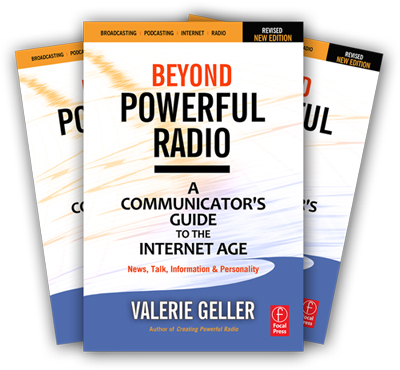
Valerie Geller is a top personality and talent coach for radio. In a nutshell, she helps build great communicators. She started working in newsrooms and eventually worked her way up to Program Director for WABC in New York. Since then, her consultancy has taken her around the world many times over. She's also proven be a highly-sought-after conference and seminar speaker as well as a highly-regarded author.
Her latest book in the Creating Powerful Radio series is titled "Beyond Powerful Radio - A Communicator's Guide to the Internet Age" - is fabulous, blending her own insights with thought pieces from leading radio experts - talent, managers, coaches, consultants, researchers and marketers (including a chapter on "Branding" by Joint Communications' John Parikhal).
AllAccess.com just interviewed her...here are some highlights:AllAccess: Your new book "Beyond Powerful Radio - A Communicator's Guide to the Internet Age" is now available -- what's new compared to the previous (and still available) "Creating Powerful Radio?" What, and who, is the new book for?
To read the rest of the article, click here
Valerie's reply: Beyond Powerful Radio is for anyone trying to navigate and become a more powerful communicator in the digital age...It's meant to be for a diverse audience of working broadcasters, both managers and talent, and people aspiring to do creative work, manage creative people or market content in any platform.
AllAccess: Speaking of Internet content, are there similarities in producing talk audio content for podcasts or streaming as opposed to broadcast?
Valerie's reply: Powerful, relevant content always wins the day. Good storytelling always works and it applies in any medium. What the internet gives you is the ability to enhance your storytelling by working with the visual component to integrate still images and video with lengthier print pieces with your audio stream or podcast. The internet also offers a new component, but it's not new to talk radio - that's the constant conversation with your audience.
To master the digital world:
2) Entertain and inform whether it is live or on-demand.
3) Keep in mind that shows that are downloaded may not be heard right away.
4) Conversely, you should also expect that when there's news of an immediate nature, or a big break in a story, people will still go to their radios, TVs, and computers with the expectation that you will give them the most immediate up-to-the moment information.
posted by Unknown @ Wednesday, May 04, 2011,
,
Radio Can Expand Client Base By Thinking Media Mix
Labels: Ad dollars, Advertising, Media Mix, Radio, Radio Ink, Selling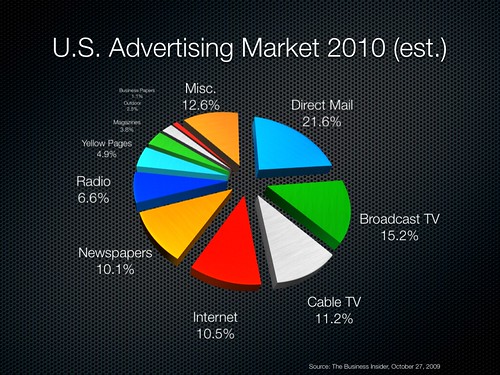
In it, David Gifford writes on why advertisers must still use radio as part of the overall media advertising mix for ad buys.
He also explains why salespeople should know how to sell a mix of media. It's the way successful salespeople are making money these days...not just by only selling your own radio station or cluster. As Radio Ink states, if you are involved with radio sales, this is an article you are going to want to make copies of and pass out to your salespeople for your next sales meeting.
The good news: radio is not dead...if you adapt (eg. innovate) the content and the value of the selling message.
Among the highlights:Media Mix translates to adding more and different ad media. Adding more ad media increases reach. Increasing reach increases advertising's cost. And overspending on reach media at the expense of driving commercial messages home re-peat-ed-ly represents the biggest mistake in advertising today.
For the full article, click here.
Witness: Whereas Procter & Gamble can afford reach, effective reach, and frequency, even with its $8 billion global ad budget, P&G can not afford "effective frequency” without radio. Inasmuch as radio is advertising's primary frequency medium, Media Mix campaigns need radio!
With advertisers becoming increasingly aware of the importance of Media Mix in all size markets, radio's obvious imperative is to get included in as many Media Mix campaigns as possible. Growth money!...
A proactive, radio-driven Media Mix campaign might include a spot radio schedule, promotions, and/or big event sponsorships, texting and Twitter, website tie-ins linked to prospects' websites, direct mail to your listener database, point-of-purchase merchandising, and partnering with outdoor to help advertisers reach those active Lifestyle consumers when they’re out shopping.
HOW TO SELL MEDIA MIX
1. Target the largest non-radio national/regional/local advertisers who can afford Media Mix.
2. Ask direct non-radio advertisers and media planners if they're open to learning about a new breakthrough approach for media planning.
3. Teach the concept of Media Mix advertising (see below to qualify which ad media apply).
4. Sell ideas and solutions to make that happen.
posted by Unknown @ Monday, March 07, 2011,
,
A Smart Viral Commercial
Love this online Smart Water commercial...great example of mocking viral videos while creating one. Does this mean 'Jen Aniston' can act as a spokesperson? Labels: Jennifer Aniston, Online Marketing, Viral Video
posted by Unknown @ Monday, March 07, 2011,
,